Pages

Saturday, July 20, 2019

Nazareth - part 2

Breakfast was served between 8:30 and 10 am on the patio outside my room. I took this as a sign Nazareth is a sleepy little town, with nothing to do before 9 am. A civilized world where I could sleep in late and still have time to enjoy the day.
My breakfast was never-ending. It was enough food to feed a family of four. There must have been twenty small plates in front of me, each with something in it from hummus to tomatoes to cucumbers to an egg, tomato, and pepper skillet dish to warm pita, etc. etc. As I thought they were done, more food came out.


I walked five minutes to Basilica of the Annunciation where I immediately bumped into Julie, Tati, Hannah, Jamie and Natalie as I was putting on my "modest attire" in order to enter the church. The five of them decided to rent a car for the weekend to go sightseeing and sleep at the Kibbutz each night. 


Outside is a covered walkway with mosaics and paintings of the Virgin Mary that were given as gifts from different countries, Catholic countries. 


Inside I listened to a Taize-style group chanting, followed by an organ playing the Hallelujah Chorus. Then silence. 

The basilica is in three parts. The entrance from the walkway leads into a quiet, simply adorned room. The main attraction is the floor below, which is visible from the ground floor. Here is the grotto where Mary was told she would become the mother of the Lord. I'm sure it looked different in her time. You walk down a ramp to have your moment in front of the sacred place.

 Upstairs, above the room we first entered, is another large room. This one is decorated with more images of Mary with Baby Jesus. Jesus is often depicted as a small man, which was a common style of artwork. One wall had Franciscan Crusader armor.


We exited out a different door, this one a few hundred feet away from the place where Joseph had his carpentry shop. I commented in an earlier blog post that everything is much closer than I imagined when I read the bible and heard the stories. His "shop" is in the basement of the St. Joseph's Church.


The next pilgrimage stop is Mary's Well, which was further away than Joseph's carpentry shop, up a slight hill. There was nothing touristic about this spot, and it would be easy to miss.


A little further up the hill was the Greek Orthodox Church of the Annunciation. The Greek Orthodox population does not believe the Basilica of the Annunciation is where the angel spoke to Mary, but instead it was here. Unfortunately for me I did not time my visit well. I was there before they opened and as they were closing 15 minutes early. I did get to peek inside. I'd say next time, but I know I am not returning to Israel.
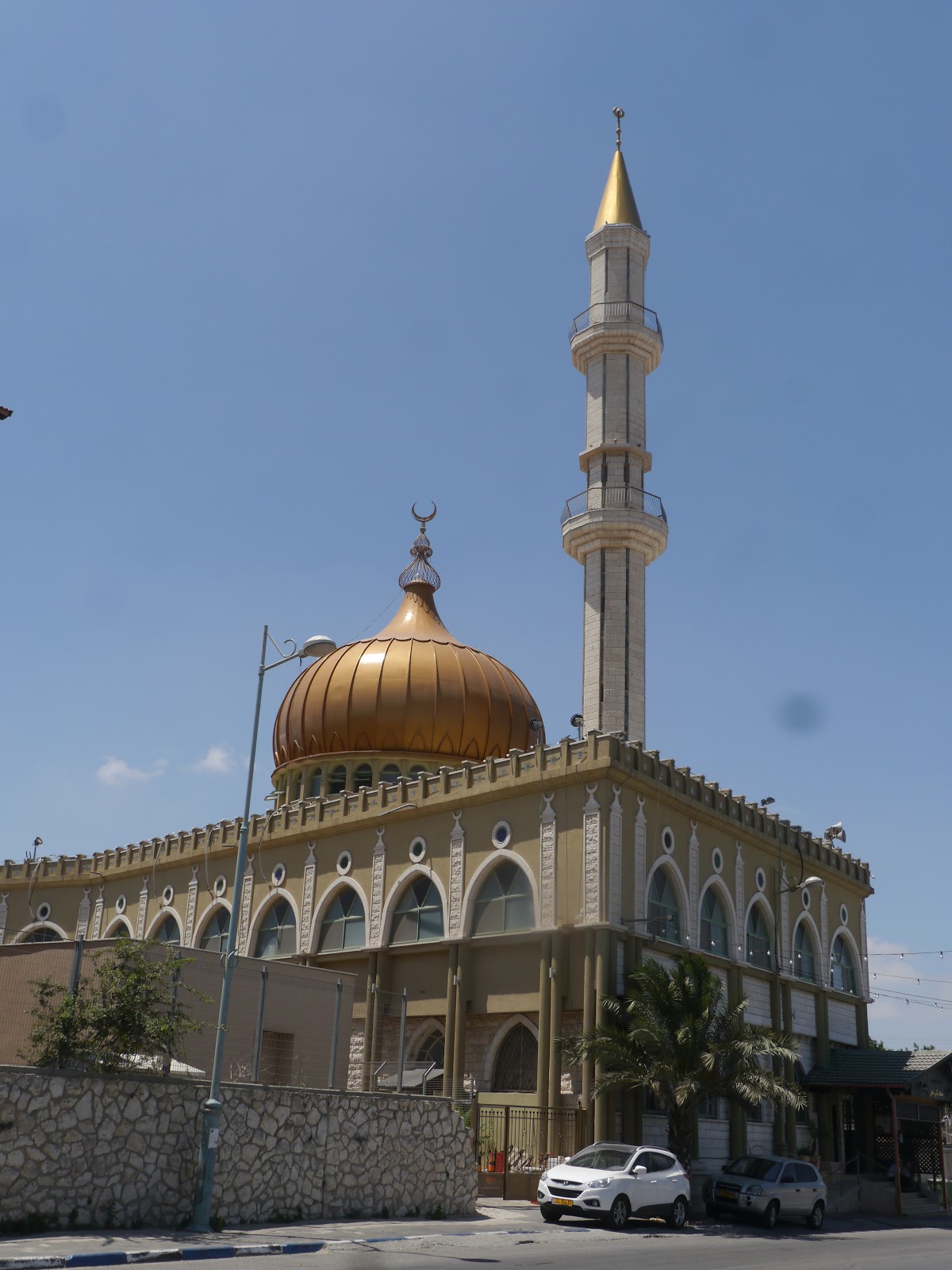
 I did walk up, up, up a giant hill to what I thought was the White Mosque. It was just a mosque that happened to be white. The view from the top of the hill was spectacular, but not worth walking over a kilometer to the top. I then walked the kilometer back down again thinking about the Masada hike the entire time.

At the mosque there were older men hanging outside. Looks like this is what they always do, sort of like the men hanging out at the Mount of Olives, another place with a fabulous view and not much else.


I made it to Abraham Hostel in time for their noon tour of the Old City. Pros and cons to the tour. It is offered for free to people staying at the hostel, or for 20 shekels ($3.50) for the rest of us. I loved the stories. I hated the extended opportunities to shop. I thought it was an hour-long tour. It was over three hours. Taking the tour meant not going to Nazareth Village -- a living history museum depicting life in Jesus's time. Can't do it all.

The tour started in a common room on the second floor. I loved the history
lesson of how the Abraham Hostel came to be, plus it was nice to sit down for a bit.

The building was built by the grandfather of Fauzi Azar. Mind you 400 years ago the Ottomans settled in that area and integrated into the culture, so 200-years old is young by local standards. Much of the building material came from Turkey, including the wood for the windows and marble for the floors. The family was wealthy. Our guide pointed out the large painting on the ceiling with Islam, Jewish, and Christian symbols. It had a chandelier even though there was no electricity 200 years ago. They used candles with mirrors to reflect the light.

Fauzi Azar inherited the house. As he grew older he did not keep up with the maintenance. He fell asleep with a fire in the fireplace that grew out of control and he died. His wife died in 1980. The place fell apart until 2005, during which time Nazareth was in a dark period -- drugs, drunks, mafia and the place was not treated well.

In 2004 the current owner went to Tel Aviv looking for a new beginning. He decided to open a hotel in Nazareth, which at the time only had one hotel. He felt this was the most harmonious city in Jerusalem, a place where Jews and Arabs live together, where King Arthur once visited. But, the Old City was falling apart. He believed in the city and fell in love with this house. To hear the tour guide, it was as if he single-handedly saved Nazareth. I'd love to know another version of the story and see how it could be applied to Trenton and other cities.

Fauzi Azar's daughter, Odette, met with him over coffee. The end result was he could live there rent-free for five years, if he paid for the renovations. That was extended to ten years. At the next contract renewal point they asked for rent. Meanwhile other businesses were encouraged to open and life came back to Nazareth.

Remember that quiet market I mentioned in the last post? It was still a quiet market the next day. Yes there were some shops open, but many are still closed.

Time to hit the streets.

Nazareth is subdivided into different sections. All the bridal salons are near each other. All the falafel restaurants are together. All the carpenter shops are together. Pros and cons to this layout. While I understand it for bridal salons, I'd rather the falafel places were spread out.

First we went into a shop with a dried up well in the basement that was too tiny for all of us to enter together. The well was 400-years old, built during the Ottoman Empire. 

As with Jerusalem, the main building materials are limestone and carpentry. The limestone is expensive to repair, so they've made patches over the centuries. Heat and humidity is not good for limestone. Every 100 years these buildings need to be renovated. The old artisans are dying off and there are not many new ones.

Our guide pointed out a metal S-shaped hook on the side of a building. It helps protect the building during earthquakes. Seems to work. She also pointed out architectural features, such as the size of windows and doorways and the presence of balconies to help us to differentiate between the different social classes. The more carvings on the house, for example, the wealthier the family.


We went into a place that was a combination storytelling salon, cafe, gift shop, and general gathering place called Ghada's Corner. We sat down for a story, Ghada has a story for everything, every item in her shop, and every person she has ever met. I think she limited herself to three stories that day. Then we had time to shop -- with a special discount, of course.

This is what I did not like about the tour. Not only did it take nearly four hours to cover a few blocks, much of that time was spent spending money, or at least being given the opportunity to spend money. Somehow I managed to escape with only purchasing a warm walnut cinnamon drink at the end.

On a positive note our guide (wish I noted her name in my book, maybe it would be easier to just make one up) said everyone celebrates all religions year-round. It is not uncommon to see Ramadan lanterns and Christmas decorations in the same block, even though they take place at different times of the year.

According to a 2017 survey, 70% of the city is Muslim, and the other 30% is Christian.

We stood in the carpenter's section of the city. Carpentry used to be a booming business (just think of Mary's husband, Joseph). Now it is dying off.

We looked at different color doors on similar-looking limestone buildings. Green doors and window frames represent Islamic families, blue and white ones are Jewish, and red are Christian doors. Guess it is appropriate our front door is painted red.

Another piece of trivia about Nazareth, it is the capital of Oriental food in Israel. If I didn't already have plans to go to Tiger Noodle a week later, I probably would have had Oriental food instead.

Our next stop was a spice store. I had walked past the doorway and looked at the variety of colors and smelled the aromas, but had not entered because I did not want to purchase anything. We have a similar shop in Hamilton, NJ (Rice 'N Spice) where I would not worry about bags being punctured in the suitcase and would be able to use the spices sooner. Plus I do not like extended opportunities to shop while on a tour.


The stories, I will admit, were interesting. She told us Arabs eat zatta (thyme, sesame, and sumac, but not salt) on everything. The mix it with olive oil.

The Elbabour Galilee Mill is the oldest spice shop in Nazareth. In one breath she said it opened 250 years ago. Another breath it opened in 1890. Even I can do the math and see that does not match. The name Elbabour means the babour or vapor, it was the name given to the old oven because it emitted so much steam. We saw the old coffee roaster.
 Our last stop (it felt like more) was the Cafe Abo Salem -- the oldest coffee shop in Israel. They have a small menu selling only four different drinks:
1) Warm Cinnamon-Walnut: this takes 2 1/2 hours each day to prepare
2) Cinnamon-Hebron Wine
3) Lemonade with hibiscus, rose water, and pomegranate
4) Arabic coffee

I went with first option.

The shop is 400 years old, run by the 20-something grandson of the original owner. Again the math does not work out. Perhaps the building itself is 400 years old, but not the business. The focal point inside the cafe is a three-ringed chandelier representing the three generations: grandfather (1914-1963), father (1963-1990), and grandson (1990-present). Hmm... the grandson must be older than he looks. Not much has changed since the business was founded over a hundred years ago, including the games they play and the furniture. In addition to being a coffee shop, it is also a gathering spot for locals. Then again, don't most local coffee shops around the world fill that need?


We returned to our starting point with one final story. Nazareth had a goal to host the pope in 2000. They planned to renovate the entire city, polish it, make it shine in less than 10 years. The dreams were unrealistic and a lot of mistakes were made. They started with improving the streets, which had the negative effect of forcing businesses to close because people could not get to their shops. The mafia and black market moved into the vacancies. There was downward spiral of people feeling unsafe, therefore they went elsewhere to shop. 

In the meantime it has turned around and is now a very safe city to visit.

I headed to the hotel to recharge. Should have visited the Greek Orthodox Church of the Annunciation, or left the tour early to go to Nazareth Village. Recharging, though, was what I needed most.

Nazareth - part 1

The strict Shabbat travel rules made it hard to sightsee when we had time off. The loophole to this rule is the Haifa to Nazareth bus route, something my suite mate, Mary, shared with me.

Haifa and Nazareth are both Arab cities. They have a wonderful, clean, express bus that runs between the two cities, even on Friday nights and Saturdays. The bus has WiFi and only costs 18 shekels, a little over 5 dollars, for the one hour ride. Take that NJ Transit!

Nazareth is a work in progress. A decade ago it was not a safe place to travel, to the extent they only had one hotel because they did not have any tourists to justify more. The place was run by the "black market," which I interpreted as the Mafia. 

Today there are dozens of places to stay from an Abraham Hostel to American looking hotels to boutique bed and breakfasts to probably other options. I never once felt unsafe walking around the city, even at night. 

My first thought at the bus dropped me off at, what I thought was the Central Bus station, was what have I gotten myself into. Instead of a bus station, I was dropped off in front of the main McDonald's. I thought I will never find this place again. Turns out I did find it again, but the bus I wanted for the next leg of my adventures was a 20-minute walk away at a giant mall (which I did not go into). 

My next thought, after wandering around the city, was this is exactly what I needed. I needed to be alone. I needed to be someplace new. I needed the freedom to not be on a schedule. I needed to be someplace with Christian roots (even though now it is an Arab city). 

In short, this trip was good for my soul. 

In the plush bus I read my Lonely Planet tour book. It said instead of street names, the streets are numbered. Best to just wander around the city and not worry about getting lost. Oh boy. THIS should make finding the bed and breakfast a challenge to find!


When I finally found the place (after asking anyone who spoke English for directions, which I call bread crumbs) I found Abraham Hostel, the place I thought I had booked a room in. They guided me to where I was staying. When I arrived there was no one there to check me in, only a woman speaking French on her phone (another guest, it turned out) who said I had to call the hotel. Not going to do since I did not have a calling plan in Israel. I went back to the Abraham Hostel. Turns out the guy at the front desk is good friends with the guy at the Nazareth Bed and Breakfast. They chatted. I walked back (less than half a mile away) and was settled in my room within minutes with a loaner converter for my cell phone.

In the end, I was glad I stayed at the Nazareth Guest House. It was much quieter. It was on a residential, pedestrian street next to a church. I heard more roosters crowing than people. The Abraham Hostel (called Fauzi Azar here) would have had a lot more people in it and more opportunities for conversation. As is, I kept bumping into the French woman and her Italian husband and had conversations in Franglais (a combination of French and English). We exchanged conversations, but not names.

I walked through the quiet marketplace envisioning a bustling place in the morning, and enjoying the solitude.
 

The French woman woman recommended a restaurant that was highly rated. The same recommendation came up several other times, perhaps because there really aren't many places to eat in Nazareth, but perhaps because it really is that good. Alreda does not accept credit cards, but it does accept Shekels, Euros, and US Dollars. The exchange rate was excellent (better than I would get at a bank) so I chose that option. I even returned for dinner the next night.


The first night I met an older Jewish man from Haifa. I'd call him a secular Jew. He said he enjoys coming to Nazareth a couple of weekends a month to escape the Shabbat rules. Hearing I was from New Jersey he gave me his already read International New York Times. It was a sweet gesture. I didn't realize the international version includes dated Calvin and Hobbes and Dilbert cartoons. In his opinion Akko and Haifa are too polluted. The country is small, not enough room for tourists and factories. He kindly left me alone while I ate so I could savor my al fresco meal in a tiny, dark patio next to the large room. As the restaurant had a sign saying smokers were welcome, I was glad no one took them up on that while I was eating dinner. Someone did the following night as I was finishing my meal.

As one could order either a meat or a dairy meal, the first day I opted for a dairy meal (goat cheese, tomatoes, and lots of spices) and the second day I a sausage dinner. Both were excellent and I still remember the spices.

As I ate dinner I heard the call to worship. Muslims pray five times a day. I think I only heard chants at four different times of day. Definitely heard them around 7:30PM, at sunset, and at 9:15 pm. This was followed by church bells at 10 PM. While I loved the neighborhood sounds, it made me realize just how quiet the Kibbutz is.

Friday, July 19, 2019

Dig Week Three (days 11-15)

Writing a week at a time seemed to work for week two, so I'll try it for week three and see what happens.

I quickly fell into a routine back at "the house," or if you prefer "base camp." I know I said on day four or five that I wanted to flip between the two, but that never happened. The plan was once they stopped using the big tools and went to the smaller ones (the ones I could maneuver) I would go back. I learned around day 20 my square never switched to the small tools, and I came to adore the people who stayed behind.

For the most part this week I rotated pottery from drying in the sun to bags and put more pottery out to dry. I aimed to do this after the sun came up around 5:30 AM, but before it got too hot. 


 I then took a spell inside labeling pottery with finicky pens.

One day I photographed pottery under Revital's guidance.

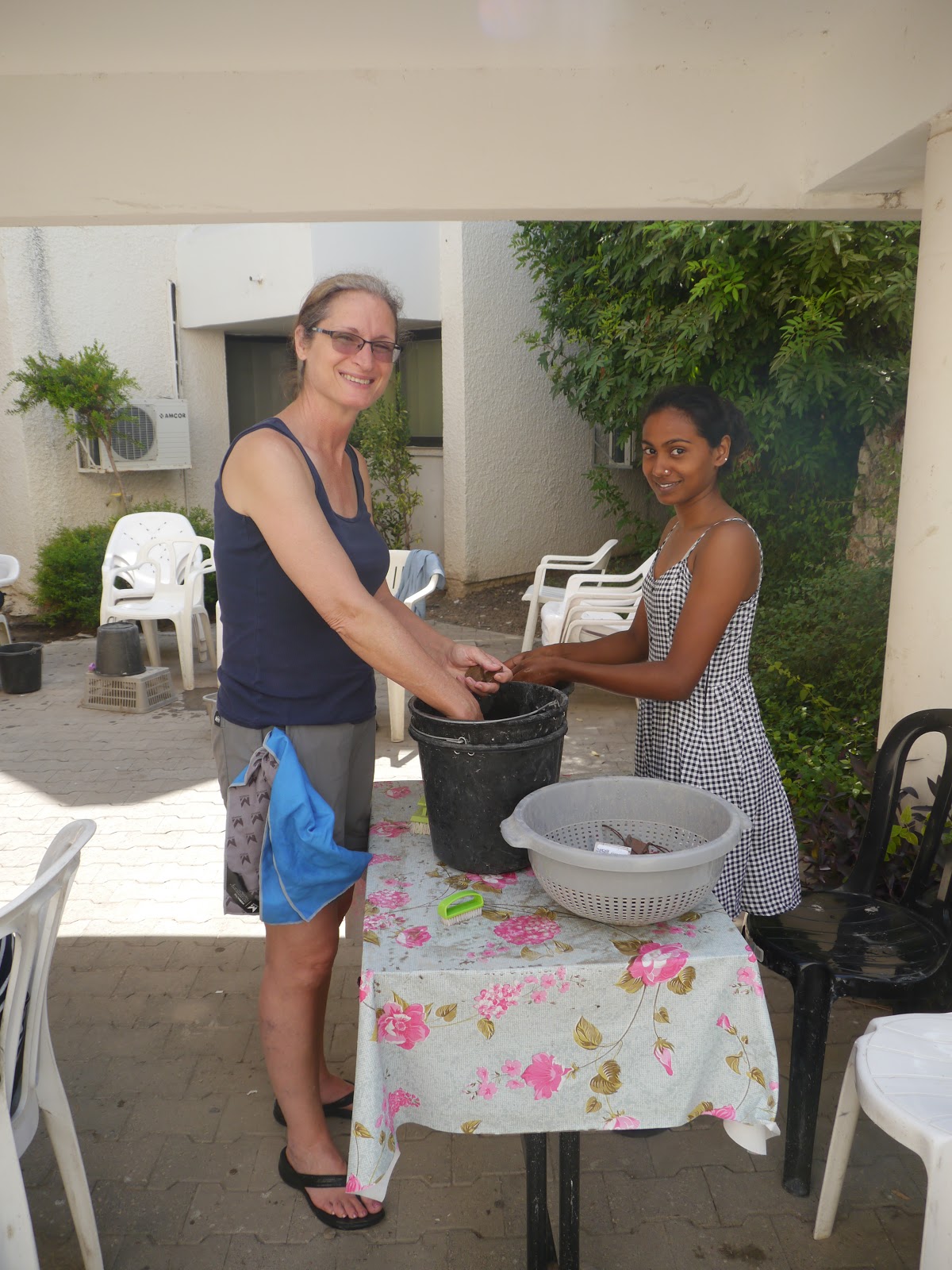
I also washed pottery with Ahlam and her mother, Fahrer, the Arab ladies.
Julie with one of the volunteers who left early.

The Arab ladies took to spoiling us. Though we didn't speak the same language, we would share fun pottery finds, dance around, and mostly laugh together. Laughing is so rare in our culture.

They also instituted our own Fruit Break after second breakfast. Each day they brought us a melon or watermelon and cut it up. We hung out together, just like they did at the dig site but our break was at 9:30 AM instead of noon.

Meanwhile, Sandy taught me the computer system called OCHRE that she designed and I was tasked with uploading pottery pictures -- in theory this would help them rap things up sooner. I was going home on July 27th no matter what, but the supervisors were sticking around longer to finish work.

Sandy was impressed by how quickly I picked up OCHRE. Took every bit of my fiber to not say "told you so."

The next day was more of the same. By now the  soil expert joined the team. He showed me his machine. I pretended to understand it. Each day people who stayed behind for one reason or another sifted through his soil samples as if they were miners hunting for specks of gold. I'm surprised I never did get a turn at that, but I was busy the whole time.


Day 13 was our heat wave -- reaching over 100 degrees. Instead of going for a walk that day I returned to the museum on the Kibbutz and soaked up its air conditioning and solitude. Normally I used that time to go for a walk.

The chef was in the hospital that week so meals were moved to different locations. A couple of times we dined in the school cafeteria with the students, which felt so un-American to me -- no background checks on us, just pure trust we were the good guys. Odd in a country with so many machine guns. At night we dined in the guest house, a further hike but with much better food. Fortunately the chef recovered and a new chef was brought on a few days later to help him make a full recovery.

On Thursday night while dining in the Guest House, we celebrated Sandy's birthday. As more often than not, she celebrates her birthday on a dig site surrounded by new friends, she has taken to playing the game of birthday paradox. The deal is, when at least 23 people are gathered, at least two will have the same birthday. In a room of 48 people, we had FIVE birthday pairs, and a birthday triplet. The most Sandy has ever encountered while playing this game. Turned out Julie was matched with Revital, and I was matched with Batami -- the pottery ladies we had been working with all month.

One frustration for Julie and I was that the volunteers who stayed back at the house (some for a day to recover, others for many days) took it as a vacation. One guy missed at least six dig days due to oversleeping, then didn't show up until lunchtime. As the older people part of us wanted to shake these kids (some of whom were older than us), but opted for passive-aggressively reminding them we DO work from 5 AM until after they come back at 1:30 PM. We were just paying volunteers. It was the job of the paid staff to manage the volunteers, we did not have that kind of power, nor did we want it.

I was having the feeling that people think we did nothing all day. The hardest working volunteer came down at 6 and spread the word that we don't do much all day. True we did not lift heavy equipment, but I did feel as if we were pulling our weight in other ways. Julie would start at 4:15 am by setting up first breakfast.

This is also when I noticed what a revolving door this dig site was. People came for a couple of weeks at the beginning or the end. They left early because of things happening at home. They started later because of life at home. Why was I there for all four weeks other than I made a commitment and honored it?

Feelings were hurt in the third week.

Monday, July 15, 2019

Lecture - Dig Day 11

Liz gave tonight's lecture on Ancient Israel. 

History, another topic I understand.

Liz gave us the historical context for where we were digging based on archaeological remains found at Tel Lachosh and the region.


In 925 BC Israel is to the north, and Judah to the south/ 

In 721 BC the Assyrian king conquers Israel. This is part of the missing years we have not discovered at Tel Keisan.

Jerusalem, the capital of the south, has a population of 25,000 people (less than modern day Lawrenceville, NJ). Urban centers had about 1,000 people at the time. Villages had between 50 and 300 people.

The lifespan for women, if they made it past age 4, was 20-30 years. Men lived closer to 40 years because they did not die in childbirth (duh). The average family size was two to three surviving children. Infant mortality was 50%, which sounds scary until you realize worldwide it is 49.4%.

A typical house had a courtyard with animals on the first floor, which were kept inside to stay safe. On the second story they kept storage jars and slept. Most homes had a roof. The homes were small.

People ate sheep, goats, fish, birds, insects, grains (wheat, barley, millet), vegetables (lentil, peas, beans, root vegetables), fruits (olives, grapes, pomegranate), nuts, seeds, dairy, and liquid. 

Women's work included food prep, grinding stones, they had three ovens, women would gather together to grind and gossip. It would take 100 hours to spin enough wool to create one item.

Men were farmers, administrators, soldiers, herders, and merchants.

The economy was market to exchange things. They all had to pay money to the king. The market was located between the inner and outer gates.

They had a proto-Canaanite alphabet.

Life was based on the agrarian calendar.

They had religious beliefs and practices and holy times (new moon, Passover, Shavout, Sukkot). There were multiple temples where they learned the stories of their ancestors. 

There is also evidence they had musical instruments.

Only the wealthy had tombs. Many dead people are unaccounted for. My last note is "mass graves were for the losers." I suspect Liz phrased that in a more politically correct way.

Sunday, July 14, 2019

Megiddo -- Better known as Armageddon

Each Sunday the dig leaders organized a road trip for us to see different archaeological sites. This was both fun and frustrating. On Friday night and most of Saturday there were Shabbat travel restrictions -- meaning the buses and trains did not run, making travel nearly impossible. 

Those restrictions were lifted on Sundays leaving me with the choice: take the free road trip or pay money to go someplace else.
The first Sunday I opted to go to Haifa on my own, about an hour bus ride from the Kibbutz. I enjoyed seeing the Baha'i Garden and walking around the industrial city.

The second Sunday I opted to go on the field trip to Megiddo, which some refer to as the Armageddon referred to in Revelations. Nothing like a trip to Israel to bring the Bible to life.

Matt Adams, a friend of our leader, led us on a tour of Megiddo and his site, Legio, which was a stone's throw away.

Sort of sad to say, but after two weeks of living on a Kibbutz the highlight for many was the gift shop. Not the only highlight, but this was the first place many had to purchase a post card, or a sun hat, or a book. I was smart and also bought a stamp. It took me another week to find an opportunity to mail the post card, but at least I could. Others bought hats and souvenirs. 

Some were traveling beyond the four-week experience, but for others this was their only chance to play tourist.

Onto the main attraction...the dig site.

Megiddo is a major archaeological attraction. The University of Chicago (the same organization sponsoring our dig, Tell Keisan) began digging there in the 1920s with money from the Rockefellers ... ah, the good old days. There have been three major excavations over the century. In 1902 G. Shumaker dug through 5 major strata, which today they consider 32 different strata. He conducted a major survey of the Tell. 


In the 1920s and 1930s the University of Chicago and the Rockefeller money funded the project. One thing left from their day is their dig house, now a third of its original size it houses a small museum (due to be updated), a gift shop, bathrooms, a restaurant, and various other offices. They went in with the grand plan of stripping all of the strata and not stopping until they hit the absolute bottom (in my neck of the woods it would be digging to China, but not sure geographically where they would end up starting in Israel). Soon they realized that was an enormous goal and decided to focus energies on a smaller area. They made it to the early 1900s BC, otherwise known as the Early Bronze Age (EBA sometimes tossed about to confuse neophytes like me).

This excavation included finding the 12 gates (or some of them) that used to beentrance points to the city, three temples from the EBA I (look at me getting fancy) or about 4500 BCE, give or take a few years. The dig was mostly interested in Biblical times, or stratum 5 and 4, or 900-730 BC -- coincidentally (or not) the same time period we were digging at Tell Keisan. The Assyrians conquered the area in 730 BC, destroying it, and building an Assyrian city in its place.

The digging continues on an every other year basis, with the in-between year for research and writing. Similar to the plan at Tell Keisan. 

Megiddo is a tell site. Tell means the city was on a mound in the middle of a plain, or that is the best explanation I grasped after being there for four weeks. The third excavation focused on digging 2 1/2 meters into the site (about 8 feet). The site is now part of a national park, and the park commission is paying for the dig before they do another construction project. It was deemed to be a quick three-week project. It was the ONLY excavation project in the history of Megiddo to find NOTHING.

Before Strata 6 was the Iron Age I. The entire city burnt to a crisp ("the red city") and a pile of collapsed brick left two million people dead. We are getting closer to that level at Tell Keisan.

We headed outside to see the dig site. Looks a lot more impressive than Tell Keisan, which it should since people have been digging there for about 100 years.


We learned about the history of the Egyptians being there, and the 4-chamber gate from the Late Bronze Age. King Solomon is presumed to have spent some time here, but as with most things there are challenges with coming up with the exact date for the 6-chamber gate they are currently excavating. A lot more is known about archaeology now than was known a hundred years ago, they are trying to go back in time and apply modern technology to old finds.

There is a lot of speculation about what Megiddo really was in its heyday. The most prominent theory is that it was a giant stable. They have iron horse sculptures to help the narrative. You have to pay to visit this site (the dig paid for our admission). Tourism is big. The place must look pretty with safe paths.

The temple found here is the largest temple for its day. Only the one at Mesopotamia is about the same size. 

Matt, our guide, is partial to Megiddo because when he was in high school this was his first dig site. Early on (first or second day, or something like that) he discovered the altar. Now his site is down the hill at our next stop, Legio.

The dig supervisors were drooling a bit when we arrived at Legio. 

They have electronic surveillance. We have the father and son team related to the pottery ladies sitting in a truck.

They have power tools (tractors). We have hand tools.

They have a permanent structure for storing tools and an office. We have a couple of small sheds and folding tables.


They have been digging about the same length of time as Tell Keisan. In 2013 they did a test dig based on a hypothesis. The first day they found proof of roof tiles with the Legios stamp on it. This is now their third dig season. They also found the earliest reference to Jesus dating back to the third century and an early church. There is evidence of gutters and a sewer system. They found a Roman garbage pit filled with things such as coins, glass fragments, and animal bones. 

We've found pottery, animal bones, and some walls that don't seem to connect.


Area B, the prinkipia, is a terraced area built on a slope. They dug through the roof tile to the floor, finding it easy to dig here. One exciting find was a Roman era two-seater latrine inside the building.


The two-seater

That day they found a Roman-style temple, but that part of the site was covered up before we could see it. Quitting time comes early when you start work at 4:30.

I failed to mention, this site works six days a week, Sunday through Friday. Beginning to appreciate having Sundays off.

Is this area really the Armageddon referenced in the Bible? Maybe, maybe not. By 67 to 135 AD there was a strong undercurrent of rebellion against Rome. The legions here created a battle plan. Somehow this ties to Revelations, which takes place in 90 AD. Armageddon is about destroying the 6th Legion, which was here. It was hard to take notes and walk at the same time. I know I missed a lot. As someone later said when I complained about being able to take notes during the tour, he said Matt wasn't giving a lecture where he expected people to take notes (which made it sound like it was my fault for even trying).

Done with people. 

Back at the Kibbutz only 10% of my clothes came back because a water line broke. The rest was promised the next day. Fortunately the rest did arrive the next day.