Pages

Tuesday, October 16, 2018

L'Atelier des Lumieres

The day before I left for Paris, I perused Princeton University's travel section and saw Lonely Planet's book Best of Travel 2018,which came out in October 2017. I scanned the book for ideas of things to do in Paris. I noted two: Soul Kitchen, a vegetarian restaurant open for breakfast and lunch in Montmartre, and the exhibit L'Atelier des Lumieres. While in Paris, my sister Becca messaged me to tell me about the atelier exhibit. While in Paris I asked people about it -- everyone knew about it, those who had attended it raved about the exhibit.


It is run by Culturespace in a vacant warehouse. Based on their website, people are given the impression they have the space to themselves. On the other hand, the website emphasizes the importance of buying tickets in advance because of the long lines. I was lucky, there were only a handful of people in line ahead of me. When I left over an hour ago, the line was much longer.

So what is an Alelier des Lumieres? Basically it is a light and sound show. I have seen similar ones outside, such as in Ottawa in the summer of 2016, but this was the first time I saw one indoors. The experience was immersive. Soft music was playing as images by Gustav Klimt (1862-1918), Hundertwasser (1928-2000), and one called Poetic_Ai Contemporary Work morphed and moved on the warehouse walls. People sat all over the place. For the most part, they were silently mesmerized during the three videos. The exhibit has been extended through January 6, 2019.

Here are some pictures from inside the exhibit. Despite the No Photography signs, people were holding up their cell phones and taking pictures. I wanted to capture the feeling. The lights change and the walls and floors are transformed. The music was soft enough to accompany the images without distracting from the main focus -- the art.


Between each of the three sections credits rolled an a note appeared. The whole show took about an hour.


Monday, October 15, 2018

Left Bank Tour

Wearing my Notre Dame (High School)
shirt in front of Notre Dame (Cathedral)
Success! I met up with Marie, the Discover Walks Left Bank tour guide, on time in front of the horse by Notre Dame Cathedral. She was my favorite guide. In part because the group was small enough we took a break for the best croissant in Paris, but mostly because of the details she shared with us. I later learned she normally does private tours. 

Paris dates back to the 3rd century BC when it was called Lutetia.

The nickname for policemen is poulet because the first police station was near the chicken market (now a flower market). They don't like
that nickname. The one I was familiar with is flic, which was a good guess but the wrong answer.

For the second time Hotel Dieu was pointed out on a tour. Dating back to 651, it is the oldest hospital in Paris. It is free. The word Hotel refers to hospitality. Dieu is because it is (was) run by nuns, whose job it was to help you die with dignity. The building is from the 1400's and is in the Italian Renaissance Style.


Marie led us inside to the courtyard. There is a statue of Guillaume Dupuytien, the man how invented hand surgery. Upon graduation, tradition called for students to enter the courtyard and dress him up with paint and clothing, which someone else then had to clean up. I hope the above link works, otherwise google his name and images. About four months ago they covered his statue in a plastic box to thwart the students from being able to do it again. Time will tell if that really stops them.

Back to the tour.

The Right Bank of the Seine River is the North. The Left Bank is the South. We headed south across Le Pont au Change -- the moneylenders' bridge. During the Middle Ages the moneylenders, jewelers, goldsmiths, and bankers had a double row of businesses along this bridge. This was the only place where they could practice their trade. People had to pay a tax in order to cross the bridge. The bridge burned down in 1621 and was rebuilt in stone about 20 years later.


Today iconic green bouquinstes line the sides of the Seine. These charming green boxes have sold used books since the 1600's. They are passed down from one generation to the next. While they can sell other items, the true spirit must be to sell books. It is an UNESCO site.

The Latin Quarter got its name because the Sorbonne University students would speak Latin to each other.

We passed the oldest tree in Paris (from the 1600's), which is by St. Julien le Pauvre, a Roman-style church built in Gothic times. It is one of the oldest churches in Paris.

Next we passed Shakespeare and Company -- a famous English bookstore. This is not the original shop. The original 1919 shop on rue de l'Odeon opened by author Sylvia Beach so expats could read anything they wanted to, and so she could help starving writers. It was a cultural center for English speaking people in Paris. Writers could stay there if they:
1) read a book a day
2) wrote about their time in Paris
3) helped out in the shop.

Ms. Beach refused to sell books to a Nazi so her shop was torched. In the late 1950s, Ms. Beach bequeathed the name to George Whitman who opened the shop in its current location and lived there until his death in 2011. His daughter, Sylvia Beach Whitman, is the current proprietress. 

In front of Shakespeare and Company is a green Wallace fountain. Once seen, I could not un-see it. According to this article, there were 50 fountains built to provide free, drinkable water. They are mostly iron painted green in order to blend in with the park-like feel of Paris. Now that I know this, I will be refilling my water bottle at them. The city does close them from November to March in order to keep the pipes from freezing.

Space Invader street art appears throughout Paris, and the world. Created by UFA (Unidentified Free Artist) these mosaics of monsters pop out on sides of buildings. Another case of once seen, cannot un-see.

We passed the famous Caveau des Oubliettes jazz club. Following World War II some black GIs stayed in Paris and built jazz clubs rather than return to the restrictions of the United States. This one's name comes from the nickname for the king's prison -- once you enter, people forget (oublier) about you. For many years they had an active guillotine inside this bar, until someone realized a guillotine is not a good thing to have around drunk people. Go figure. The club was recently sold.

Like Le Marais, the Latin Quarter has twisty, windy Medieval streets. It, too, was not destroyed by Baron Haussman in the 19th century because it was the poor district where the students lived. The area still has some "belly houses" from that era -- homes built with slanted limestone walls to prevent fires from spreading.

Some non-sequiturs:
* the trashcan (poubelle) was named after Eugene Poubelle
* 70% of Parisians don't own a car
* rue des Anglais got its name from where the English (Anglais) settled
* universities used to be outdoors, students would sit on haystacks

Continuing on to boulevard St. Germain. Marie pointed to a building and asked us to identify which floor was where the wealthiest people lived. The correct answer is (what us Americans) call the third floor. It is the one with the highest ceilings and fanciest windows. The top floors were for the hired help (chambres des bonnes).

Our group was small and our guide efficient, so we made a quick stop at La Maison d'Isabele, winner of the 2018 first prize for best croissant. I opted for a petit pain au chocolat instead -- chocolate croissant. 

Marie pointed up the 57 meter tall hill to the Pantheon. Next she showed us Astronomy Tower in the biology and chemistry department at Sorbonne. Unfortunately the tower is not still in use, but it is built into the wall of the building. La Sorbonne was founded in 1253 by King Francis I so men could receive a free education in French. Early subjects included useful ones such as theology, history, astronomy, and philosophy. Education was free, but they did not receive a diploma. The first class had fifty students. By the end of the century, 1,000 students were enrolled. They couldn't afford to feed the students.

Cardinal Richelieu (the bad guy in the "Three Musketeers") gave money to the
university with the catch that they must include a chapel inside and that he would be buried in that chapel. During the French Revolution, students stole his skull. Today Sorbonne is made up of several universities, each with their own specialties. Paris VIII (where I was an exchange student) is not one of them. On the walls of the Sorbonne are statues of things you can study. 

In May 1968 the student riots happened here. They fought for improvements to the quality of education, especially improvements to the buildings. The occupation lasted a few months and spread to offices and factories. HERE is a 2018 New York Times article about it. Change happened. 

Famous people associated with Sorbonne include Jackie Kennedy (who was a student), and Marie Curie, the first female professor.

We passed yet another shop called Au Vieux Campeurs (old campers). Marie counted 26 on this walk. Most of them are in this neighborhood. Some across the street from each other. They sell camping equipment. Marie finds it a bit
fishy. 

The Musee de Cluny is dedicated to the Middle Ages that was closed for many years. It is built on the former Roman Baths. I did not go inside, but was told they have a unicorn horn on display.

We all rubbed Montaigne's foot for good luck. So far nothing lucky has happened (unlike the quick turn around from when I rubbed the toe of
the statue in St. Petersburg), but nothing unlucky has happened, either. Speaking of good luck, wishing an actor beaucoup merde before a show is good luck. Back in the day only the wealthy could afford to go to the theater. They would arrive in horse drawn carriages. At the end of the night, the theater would be filled with horse shit (merde). Lots of merde meant lots of people went to the show. Up there with break a leg, because that means you bowed a lot after the performance.

Our tour guide then points to some street art that popped up over the summer as a tribute to the May 1968 uprisings. Bristol artist Bansky quietly created between 10 and 12 paintings on buildings, which were later confirmed by his social media account. 


We turned to look at the Pantheon. The word pantheon means to all the gods. Louis XV christened the Pantheon as the "mausoleum of France." It was built by Soufflot in 1742 and finished in 1790, after his death. The important people of France -- French Revolutionary War heroes, philosophers, Victor Hugo, and Rousseau are among the 76 slots taken. There are still 224 places for people to be buried. Six women (including Marie Curie) are buried there. Most of the other women there are because they are resting with their husbands. Last year Holocaust survivor Simone Veil (a major political figure) was interred at the Pantheon. Her husband Antoine, who passed away in 2013, was brought over to rest with her. Veil was the first woman representative of the European Union and fought for women's rights to abortions.

That is where the tour ended. Marie suggested we dine at Le Pipes, but I decided to press on to the Lumieres and Ateliers exhibit I read about the day before I left for Paris.

Sunday, October 14, 2018

American Church in Paris

My trip to Paris leading up to the Disneyland Half Marathon was very open. Last year I carved out time to see where I lived as an exchange student in the Fall of 1990. The year before I spent time on the campus of Paris VIII. This year I decided to spend some time at the church where I attended worship and played in the bell choir. The Paris tourist bureau will never ask me for sightseeing suggestions based on my past trips.

The American Church in Paris was a little home away from home for me. I was there most Sundays for worship, and mid-week for bell choir practice. Sundays after worship they hosted a dinner that was cheap even by student standards, the meals were both filling for the body and soul. It took me nearly an hour by train, metro, and 10-minute walk, but worth it. I was pleased to see the night I landed they were hosting a rare evening dinner and discussion. As a college student, I would not have enjoyed the discussion, but as an adult I found it fascinating.

The topic for the Wednesday night Thurber Lecture Series dinner and discussion was Renewing the Church. Dr. Brenda Salter McNeil flew in from Seattle, Washington with her husband Dr. J. Derek McNeil, also a preacher, to lead the discussion on reconciliation with the church.

We were all handed slips on paper on which we were to jot questions in order to ask questions on the end. Many people, myself included, used the slips of paper to write notes. She was so fascinating, I didn't want to lose the thoughts.

Dr. Brenda, as she is referred to on her website, is a black Pentecostal female preacher from the United States. Not long after she was ordained about 30
years ago she and her husband were invited to an old, predominantly white, Anglican church in England to talk about how to revitalize their churches. The church leaders recognized the African American churches were thriving while their churches were flagging. She said "God is united people who don't look like each other." She continued to say "this is Kairos time, the right time, set time, pregnant time." God works in Kairos time, not in human time.

"By 2020, whites will be an ethnic minority in the United States. We are God's ambassadors, we must discern Kairos moments." Dr. Brenda pointed to the economic instability in the United States and around the globe. There is a lot of fear in the world, many addictions, feelings of being unsafe, that "the wine has run out." She sees this as a time that the Spirit is nudging us, telling us it is our turn to make change. He exists in all cultures, we should embrace that and work together to make change.  We need help from other people.

The Anglicans asked many questions of Dr. Brenda and Dr. Derek to see how they can change. "Yours is a young and agile church," John Modeford(?) a leader in the Anglican Church said. "Ours is old and arthritic. We need you to wait for us to catch up." At that moment they recognized they are there for each other. Neither one holds the key for the future. 

The Gospel is strong in Africa. They believe God is alive and well. He will work with you. Be free of the spirit of fear. "We are called to a massive leap of faith in these difficult times. Let's work together in this Kairos moment."

I left soon after her talk. While I was enjoying the fellowship and conversation, it was after 9:30 and I knew I still had an hour trek ahead of me -- a bus to the metro to walk to the room, with the uncertainty of how long connections would take. Fortunately I am comfortable navigating Paris by mass transit and had activated my week-long Carte Navigo transportation pass.

After dinner I studied the sign listing when they are open for tours. There was only a 90-minute window of opportunity -- the following morning between 9:30 and 11 AM. I made my plans accordingly.

The church was smaller than I remembered.  


I spoke with the church sexton. He said the church is only open a few hours a week for visitors because the other times they are using the sanctuary for weddings, baptisms, and renewal ceremonies. Even on the Thursday I visited, the church was planning to have four weddings. Mid-week!

The sexton showed me the plaque dedicated to Music Director Fred Gramann on the 40th anniversary of his service. He is now up to 42 years. I played in his bell choir nearly 30 years ago. Unfortunately I did not see him, but I did hear someone practicing the organ. Fred is has published choral and handbell music. I'm sorry our paths did not cross.

I am grateful I was able to go inside. With the race on Sunday, being able to stop by for worship was out. The other option was the concert by a Philippine choir on Friday night, but then I would have had the same issue with getting back to where I was staying late at night. While I have always felt safe in Paris, mass transit is tiring. I made the right call as this way I was able to walk around the nooks and crannies.


I was there when Rev. Duggan was the pastor

Le Marais Tour

After missing the morning tour of the Left Bank, I made sure to arrive well in advance of the Marais tour. I found a small grocery store (is there any other kind in Paris?) and bought a pre-made salad, a bottle of water, and chocolate for lunch while I waited.

Our tour guide, Florent, showed up wearing Discover Walk's signature hot pink vest, which he ditched as quickly as possible. Florent, like all Discover Walk guides, is a native Parisian. He gives tours to pay his rent. Our tour had 28 people on it, each tips at the end of the walk.

The Marais. 

Marais in French means swamp. Until the 1200's, this area flooded. In the Middle Ages the king and the monks raised the ground, put the river bed under a road, and built up the area. It still maintains the feel of a city from the Middle Ages. Because it was spared Baron Haussmann's 19th century razing of Paris, the 17th century hotels particuliers (private mansions) still stand, as do the twisty, narrow roads. Haussmann ignored this area stretching between the 3rd and 4th arrondisments because it was deemed not worthy -- it was where the Jewish and other poorer people lived. Until the 1980's it was still a cheap place to live (at least cheap by Parisian standards). Today it is one of the most expensive parts of town filled with art galleries, hipsters, gay people, and Jews.  

Sounds like it is quite amazing the area has maintained its charmed. In addition to Haussmann's plan, in 1925 there was a plan to build a 200 meter tower, and in the 1940's and 1950's there were plans to destroy the factories and workshops (some of which have since been renovated into art galleries). In the 1990's, the area became trendy. Rents are around 1000 euros a month ($1,100), which the woman from Boston and I looked at each other and agree sounds like a bargain to us.

Florent showed us an entre cour et jardin he recently discovered. Basically a mansion between a courtyard and a garden, which separates the rich from the poor. They have huge doors for carriages to enter. During the French Revolution these homes were abandoned by the aristocrats, so the poor people moved in. They found the homes too expensive to heat, so they abandoned them, too. Today many of the courtyards are open to the public and the homes have been turned into art galleries.

Florent points to a restaurant down the rue de Bearn with a green awning and tells us this is a good Provencal restaurant, and affordable by Parisian standards. 

We walked into Place des Vosges, which used to be the Place Royale. The square is surrounded by buildings that have a similar style, but are each different. One side was the Queen's side. Across the square 

was the King's side. It was the place of duels. The original 1639 statue of King Louis XIII was made of bronze and melted during the French Revolution. In 1829 the statue was rebuilt with the same proportional mistake made in the first one -- the man is bigger than the horse, therefore a trunk had to be added to make it stay upright. 

It is little things like this that bring Paris alive.

Florent pointed out the City Museum (Musee Carnavalet) which has works of art by Victor Hugo (yes, the author) in it and is free, but I didn't make it there. Turns out the museum is closed for renovations. Hopefully on a future trip.

It is a quiet area where birds can be heard chirping even though we are in the middle of a major city.

I have some random notes about places we passed on our walk ... the Hotel de Sully, the National Monument Center, Roman Emperor St. Antoine, St. Catherine' Market Square, Le Marche, but no notes to flesh out these thoughts.

We walked through the early 1600's St. Paul St. Louis Church from the counter reformation era. It has the cross above the crest of the king to show the church is above the king. The Jesuit church's preacher was famous for having five hour sermons, so people brought their own toilet pots in order to not miss anything. That is dedication.

We passed an iced tea company giving out bottles of free iced tea. Free doesn't happen very often in Paris, or in most major cities.

We passed Hector Guimard Synagogue. Outside the synagogue men were selling fruit and palms
as symbols of Sukkot. Nancy told me the correct names for these. She showed me theirs after I came home.

Florent led us to a garden he said has been open since 2014. It includes part of the original 1190 wall and tower that surrounded Paris. Homes were built into the city wall. In the 1940's when the homes were destroyed (assuming during World War II, even though Paris in general did not suffer a lot of damage, this was the historically Jewish section), parts of the city wall were rediscovered.

Now for something serious ... Le Marais is home to the War of the Falafel. They take their falafel very seriously. It is between L'as du Falafel built in 1979 and Miznon, owned by Top Chef of Israel. Read the article for more details. I thought about buying a falafel, but could not make up my mind, and it was too late for lunch and too early for dinner.


Onwards to the rue du Roi de Siecle, a 14th-15th century street filled with pointed roofed homes, a style that has since been outlawed in an effort to keep fires from jumping from one home to the next.

A chocolate shop and pastry shop, both award winning, were pointed out.

On our left were two of the oldest homes in Paris -- half-timber houses built in the 1300's and renovated in the 1960's. 

Now for the somber moment of the tour. Before World War II, 110,000 Jews lived here. A quarter were deported. On the wall of the Memorial de la Shoah is a list of people recognized for rescuing Jews. Inside the memorial are ashes from death camps. Names

were still being added to the list up until a few years ago as more people were willing to come forward as Jewish supporters.

Our next stop was St.Gervais-St. Portais church. My notes say the church took 120 years to build. They started building in the back so people could worship while the church was being built -- something I hear said about the construction of other churches. Reading the article I linked to, sounds like it took over 200 years to build. Since
the 3rd century a church has stood in that location (making it the oldest church in Paris), but this church was started in 1494 and was not finished until 1620. Its big claim to fame is its organ -- the oldest in Paris. From 1656-1826 it was played on by eight members of the Couperin family. The style of the church is Gothic-Gargolyne. Bombs fell on the church during a World War II church service. The stained glass windows are a newer addition.

Across the street at the mayor's house Mayor Anne Hidelgo -- the city's first woman mayor -- turned the roads in front of the river into beaches and pedestrian zones.

Florent ended the tour by pointing out Bertillon ice cream -- the most famous ice cream in Paris. At his recommendation I had the salted butter caramel ice cream. It was even richer than the Salt and Straw in Portland, Oregon.

After having some ice cream, I went to Disneyland Paris to pick up my race bib. I hope they come up with a better system for next year.

Ile de la Cite -- Be Together Tour of Paris

I was so distracted floating back in time at the American Church in Paris, I misjudged the time and missed the start of my first scheduled free walking tour of Paris. My plan was to go on a walking tour of the Left Bank, which started at the statue in front of Notre Dame. I started walking from the American Church to Notre Dame, when I realized I wasn't going to get there on time. A quick Google search shows they are 20 minutes apart, and I suspect that does not include taking pictures along the way, or even waiting for traffic lights to change. I used my Carte Navigo pass (at 22.80 Euros, a much better deal than the tourist pass) and took a bus in the right direction. Unfortunately it turned into a neighborhood and I still lost time. 

In essence, I was late and the free walking tour left without me.

Have no fear! There was another free walking tour taking place. This one was with Be Together Tour of Paris instead of Discover Walks. And it covered places on Ile de la Cite instead of the Left Bank. And it was led by a lovely 25-year-old from Mexico instead of a local Parisian. Her age came up when she shared with us the tidbit that European students under the age of 26 can visit most museums in Paris for free. Though she is from Mexico, she is a permanent resident of France and takes advantage of that deal as often as possible.

I joined the group a little late. We were a small group, less than 10. At two hours, this was my longest walking tour. So long, our guide had us sit down and take a break at the halfway point.

When I joined the group she was telling them about this not very well-known author who wrote a story and saved Notre Dame single-handed. His name, of course, was Victor Hugo. He was paid 40,000 francs to write "Notre Dame de Paris" in 1831, which we refer to as "The Hunchback of Notre Dame" today. Based on his story, Parisians set about in the 1840s to restore the cathedral.

The tour started at a place called Paris Point Zero -- the place from which every other place in Paris, and in all of France, is measured. It is this unassuming block. Myth has it if you step over this point (as millions do daily without even noticing it) you will return to Paris. I managed to only pose for this picture with it, hope that is close enough to let me return.

Across the street from Notre Dame, but still on the island, we paused in front of Hotel Dieu, which is not a hotel, nor does it have anything to do with God (as the name Dieu would imply). Dating back to 936, it is the oldest building on the island. It is also a public
hospital free and open to the public. I made note of this since two days before I left for France I went to the emergency room with stomach pains (which, thankfully, disappeared). 

The tour continued to Place de Louis Lapin, which brings up nothing on Ile de la Cite in Google search. Here we talked about Napoleon III who was the first president of France in the 1840s. He wanted to be as great as his famous uncle (Napoleon Bonaparte) and enlisted the help of the Baron Haussmann to completely redevelop Paris -- a 17-year urban development program, possibly the first one by choice (instead of to recover after a war). Most of the tours I took on this trip talked about Haussmann, either to point out what he did do, or what he didn't do (he did order massive destruction, resulting in large boulevards like the Champs Elysees; he did not destroy the Left Bank or Le Marais).

The plan was to create a city like London, with wide avenues and lots of parks. So what if there were already a bunch of houses in the way, knock them down. He believed Paris should only be known by foot, that Medieval era buildings were ugly, and that the city should have a uniformed look -- buildings no taller than six stories, facades in light tones with darker rooftops. This was also the era when the 20 arrondisments (districts) were created. Even now, 170 years later, there are very few buildings that do not conform to the look. New buildings, even those made of glass, have to be designed in a way that they blend in with the rest of the city. 

Continuing on the tour we stopped near St. Chapelle, but did not go inside of it. At 10 euros ($11 USD) it is one of the few churches one has to pay to go inside. King Louis IX had St. Chapelle built after he returned from the Crusades. He brought back with him THE Crown of Thorns (as in the one Jesus wore when he was crucified), some nails, and the breast milk of Mary. Umm...okay. Tell me more about how that was stored. The church was built in only seven years (finished in 1248). The relics were moved to Notre Dame following the Revolution in 1789.

Next door is the Palace of Justice, a former royal palace, now the courts. The plan is by 2020 to move the business aspect of the Palace of Justice into the suburbs, and turn this historic building into a museum. This building was built in the 1760s, making it 500 years newer than St. Chapelle.

The third building is the Concierge. It was the palace for French kings from the 7th-14th centuries. During the Revolution it was a prison, housing up to 1000 people. It was conveniently located near the guillotine, which was in Tuileries Garden in Place de la Concorde. Marie Antoinette was the most famous prisoner. It is said she aged significantly while in prison and her last words were to apologize for stepping on a guard's foot by mistake. 

As we neared the corner we passed the first public clock in the city of Paris. It
was installed in 948 as a gift to King Henry III.  Later King Louis XIII added the symbols of justice. With the addition of the public clock it became easier for commoners to be able to tell time. Hard to go by the sun when there are days the sun does not shine. The clock only chimes when the king dies, or when an heir is born. As they have no more kings, I suspect that means the clock no longer chimes.

We stepped onto Pont Neuf, which means New Bridge. Built between 1578 and 1607 this name is even less accurate than New Residence Hall at my alma mater (built in the late 1980s, newer residence halls have since been built and named). The bridge was to connect the right and left banks with the island in-between. Catherine de Medici, King Henri II's wife, moved to France from Florence in 1533 and brought with her the love of art and beauty. She wanted to turn Paris into the most magnificent city, and Henri wanted his wife to be happy. She was the first to say "Paris should be enjoyed by foot," a sentiment echoed by Haussmann two centuries later. The former bridges were made out of wood, people lived in them, and businesses took place in them. They were seen as a places for houses and shops, and not as a means for getting from one side of the water to another. 

The next bridge is the Bridge of Locks, or Bridge of Sighs. It was built in 1899 for the Exposition of Paris as the first metal bridge. It is most famous for being the place where people put their initials along with the initials of who they love, snap the padlock shut, and throw the key into the Seine as a sign that their love with endure forever. In 2015 in an effort to save the bridge, the French government took all of the locks off of the bridge, and added glass panels making it difficult (though

not impossible) to add your lock to the collection. People have made new places to show their love through their padlocks. Every few months they snip off the locks that do make it. Locks can be seen all over Paris (and many other cities). Our guide said they now use the Pont d'Ilena near the Eiffel Tower instead. I did not walk that far to check it out.

We continued our tour to the Louvre Museum. Back in the beginning of the tour we learned the kings lived in the Palace of Justice until the 14th century. King Louis XIV changed that. He believed the palace was too small, or he was paranoid after a failed kidnapping attempt when he was six and did not want to live there. At the time of his reign, he was not respected. He moved the French government into different castles through France, and settled in Versailles. At the time the Louvre was much
smaller than it is today, and it is only a block away from the Palace of Justice, but that is where Louis XIV decided to live while in the city.

The fate of the Louvre was changed when in the 1830s it became a palace for the people, and was therefore saved during the 1789 Revolution. 

Rumor has it if you spent one minute looking at each work of art (and doing nothing else) it would take you five months to get out of the musuem.

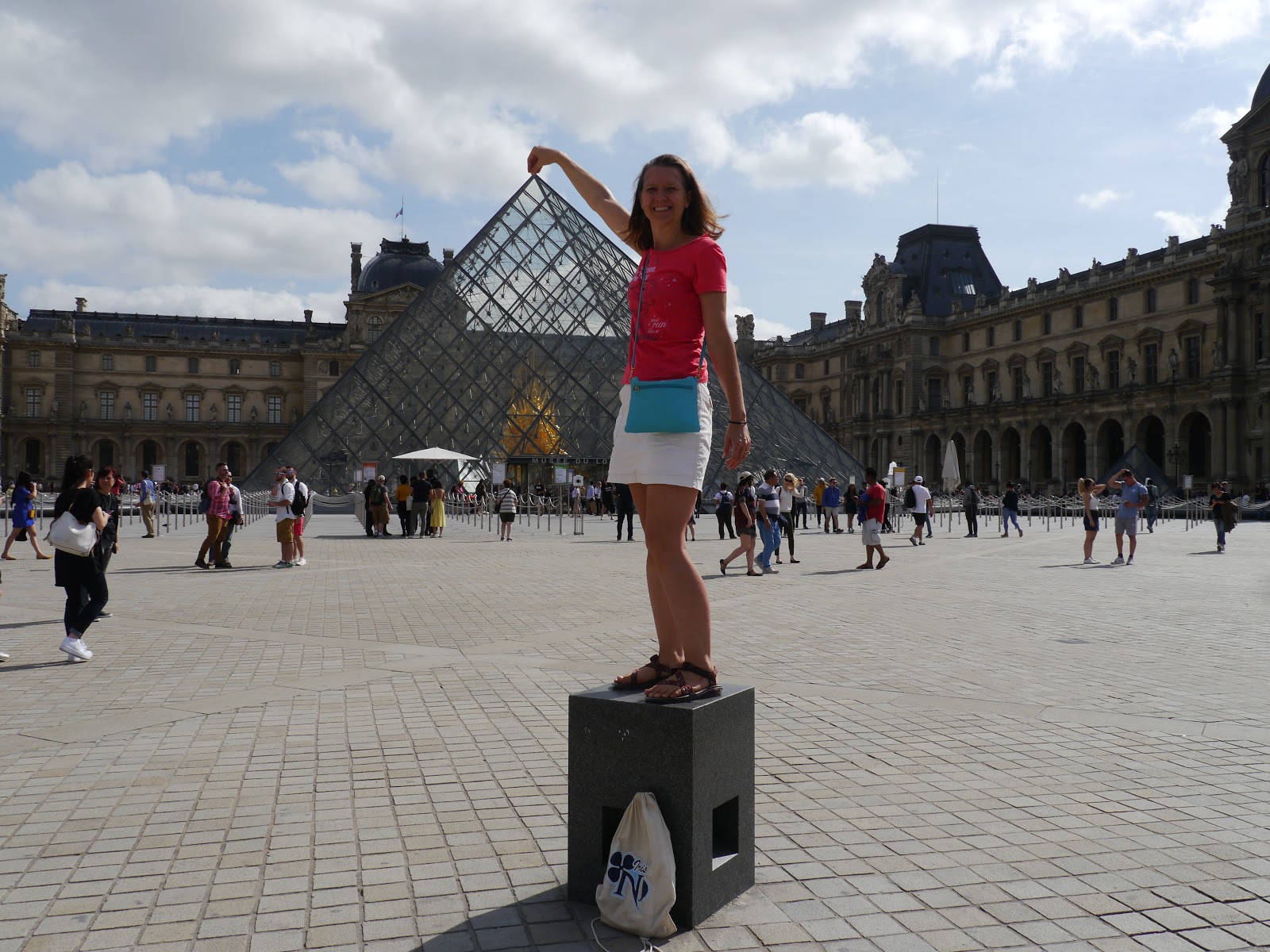
President Mitterand had the glass pyramids installed in the 1980s as a present to his mistress. They are still controversial.

We ended our tour at the Arc de Triomphe du Carrousel in the Garden of Tuileries. This is the scene of where "Les Miserables" took place when the Prussians invaded Paris. Walking under the arch gives you the blessings of the Gods. We can all use more blessings. It depicts scenes from Napoleon's triumphant Battle of Austerlitz.

Our guide ended with telling us about the obelisk, an 1831 gift from Egypt to France dating back 2,300 years. At the time France gave Egypt a copper clock. Egypt wants it back.

The tour was good, but I learned my lesson and arrived early for every tour after that.

Friday, October 5, 2018

Starting my Parisian and Belgian Adventures

I began my travel journal while sitting in Newark Airport waiting for my 12:30 AM flight to board. I was feeling restless, anxious, but most of all apprehensive. I had this feeling something was going to go wrong. Really wrong. A feeling I couldn't shake. Now that I am safely home, I can say nothing went really wrong. Many things went right. Most of all, I returned with an improved change in my thinking and about how I feel about myself.

Planning for the trip was not smooth. The Thursday early morning flight I was scheduled to be on was cancelled and I was to leave a day earlier. Which meant changing my AirBNB reservation. Unlike with a big hotel, if the AirBNB is booked that night, there is nothing I can do. Fortunately she had an opening.

Two days before I was set to leave I realized the room was much too far from the start of the race (the RER line splits in two, and I was on the opposite side of Disneyland Paris, which meant having to go into Paris to change trains and then go out again). Perhaps it is "only" a  30 minute Uber ride away, but not something I wanted to risk at 6 AM on a Sunday. The hostess would not give me a refund for the day. The same hostess who gladly accepted an extra day when I needed that. I wrote her a note in English. She replied, could I type the note since it would be easier for her to read. I did so when I cam home and have not heard back from her. It didn't help her one-way street was a drag race for motorcycles at all hours of the night and that she left the key with someone for me to figure out once I arrived. We never met in person and I don't ever care to meet her.

The information about how to pick up the race bib arrived after I arrived in Paris, and did not have access to a printer. 

Day of I learned I could only bring 10kg in my carry on (22.2 pounds). Not a lot for a 10 day trip that includes a race. I got it down to 8.6kg because they did not weigh my purse or my 1kg camera.

I was also nervous about seeing host families. I saw many of them last year and was treated like visiting royalty. Wasn't sure how the longer trip would go. In the end it was okay. Nothing bad happened, but I left feeling as if I was a burden and not feeling loved. Made me appreciate my family more. Made me look forward to seeing them again.

I was (and still am) missing Carin. I miss the back and forth daily part of our friendship the most. Hard to find a friend who has time to invest in a new friendship. I'm starting to accept it might not happen. 

When I left for the trip my temp boss (Liza) left me a very sweet note wishing me a good trip and telling me she was looking forward to seeing me when I returned. I needed to feel that love at that point.

At the airport I posted a FaceBook gripe about the trip. The response was overwhelmingly filled with love and encouragement. It was the type of complaint I would have only made to Carin, but without her needed to get it out of me and into the world. I felt better knowing there were people out there who do care about me. Easy to forget in daily life.
 
Happily nothing horrible happened on the trip. I miraculously made all of my connections (even the 10 minute one from the old train station in Lille to the new train station in Lille). Helped they held the train for those of us making the mad dash to the TGV. I survived the trip on WiFi. When I did have it, Don seemed to drop what he was doing to chat with me. That made me feel loved. 

Future posts will be about the six walking tours I took, a visit to the American Church of Paris, a museum exhibit, trip to Belgium, and day trip to Aachen, Germany. Other than this weekend's planned race and trip to Boston, I'm staying grounded for a while. One more week of temping, then I don't know what the future holds, but I am also not worried. It will work out.

Thursday, October 4, 2018

Floating through My Past

It might seem odd to start my series of posts about going to France and Belgium with coming home, but that is how I feel called to tell the story.

My story left off with starting a seven week temporary position with Firestone Library at Princeton University. After months of feeling as if I was floating, I finally felt grounded. That feeling lasted only a couple of weeks before my long-planned trip to Paris and Belgium was to leave from Newark Airport.

Back to floating, only this time while also speaking French, and carrying a suitcase that weighed less than the required 10 kg (22 pound) weight limit.

I floated through Paris. Other than the race on Sunday morning, I had no set plans from when I landed on Wednesday afternoon until Sunday morning. Floating. 

I took six walking tours in three days (each to be blogged about later), went to dinner and a tour of the American Church in Paris (where I spent time while I lived in Paris as an exchange student), saw a new art exhibit, changed rooms twice (the first one was too far from the start of the race), and floated along the side of the Seine. Better that than in the Seine.

After the race, I floated up to Liege, Belgium through three different trains -- the first from Marne la Vallee to Lille, the next to Brussels, and the third to Liege. Floating and dashing both.

I spent four days, five nights, with floating betwixt and between host families. I was wined and dined. I was shown how Liege has and has not changed. I was asked my views on politics. I was able to live as a family member again. I was able to shut one door on my past and open a new one to my future. It was what I needed.

Still, it felt like floating.

I've been home for nearly a week. Another busy week. One filled with a day trip to New York City to see a show and entertaining friends who live on the opposite side of the world (as well as mutual friends who live between us). Filled with working each day. Filled with trying to become organized again (and actually succeeding). Filled with becoming grounded once again.

Lessons learned along the way:
  • Everyone's spouse (family) annoys them. 
  • Communication is hard, even when you speak two (or more) languages). 
  • There is no place like home, and your own bed. 
  • My family is pretty awesome. 
  • Take advantage of the nice weather, especially this time of year.

While I tend to include pictures with my posts, I think I will leave this one as is -- with the imagery of my floating and feeling lost, to slowly landing and feeling grounded.

I have one more week at Princeton University. After that, I would like a week off to settle into this new reality, and to catch up on pictures, scrapbooking, and blogging, and sending out more resumes. I wonder where J&J Staffing will place me next.