Another day, another couple of tours of Paris. I started with a tour of Notre Dame de Paris with Discover Walks. Notre Dame was built from 1163 to 1345. Built in the Gothic style. In the Renaissance era the church was considered ugly. It was covered with tapestries. The church was tucked in a crowded neighborhood and barely visible. The cathedral was severely damaged in the French Revolution because it was impossible to separate Notre Dame from the monarchy. During the Middle Ages there were statues of the king inside. The king was worshiped in public.
During the French Revolution the statues were taken down and the heads were cut off. The cathedral was used as a warehouse and was left in ruins. Hard to imagine.
I was about five minutes late for Roman's tour, but fortunately he was still wearing his trademark pink vest and was still near the starting point, so I was able to join them. This tour is more academic than the other tours. While a similar length (75 minutes) it pretty much just walks three-quarters of the way around the cathedral. A lot of time was spent studying the front. There are a lot of details in the front. You see three doors (trust me, only is hidden behind me in this picture), each with an arch. Looking closer, each door is different. Having been built over two centuries, architectural styles changed. Add to that, it was renovated in the 18th century, things change. Roman emphasized nothing is on the cathedral by accident or randomly. It all serves a purpose.
Start with the two towers. They are not exactly the same because only God can make things perfect and this is a human creation.
The Rose window (in the center) at 9 meters wide (nearly 30 feet) was the largest one built by the 1240's or 1250's. According to Anglian Home, it is actually 12.9 meters (42.3 feet) wide and is the largest in the world. Perhaps I misheard. The circle is a symbol of the spirit and heaven; the box around it is the limited symbol of flesh and earth; and the two together symbolizes Mary holding Jesus. The architects wanted people to have a mystical experience with this church. I'm not an art historian, but it sounds nice to me.

Back in the early days of the cathedral, it was painted. I know it is hard to imagine. The brick path represents where walls to the shops and houses were hundreds of years ago.

 Back to the doors. There are three of them. The one on the right (when looking at the cathedral) is the plainest. It is also the earliest one. The statues are from ancient times and told stories people knew in that time. Many people were not
literate in the Middle Ages. Statues were a way to preserve faith stories. The right does are the ones now used to enter the cathedral.
Back to the doors. There are three of them. The one on the right (when looking at the cathedral) is the plainest. It is also the earliest one. The statues are from ancient times and told stories people knew in that time. Many people were not
literate in the Middle Ages. Statues were a way to preserve faith stories. The right does are the ones now used to enter the cathedral.
 We spent a lot of time looking at the center doors as they are currently not used regularly. They are very ornate. Jesus is in the center (just below the arch) and is opening the graves on judgement day. The angels are blowing trumpets. The belief in the Middle Ages was everyone waited until the end of time "and all the dead shall wake up to face judgment together." Individuality was not a concept, unlike today where Christians believe we go to heaven as soon as we die. Four architects worked on this door. The left side represents people going up to paradise. On the left people are going to Hell (if you are that interested, I trust you can find better close up images). In the middle is St. Michael. Jesus is above all sitting on the throne. When this was built, Jesus's and his blood were in Paris. The relics were destroyed during the French Revolution. The crown of thorns is still here and is visible on the first Friday of every month. Above Jesus is heaven with the saints.

In the statues is Judas holding the purse to show the evils of man. There is also a headless statue representing St. Denis of Montmartre. Under the saints, the seven deadly sins are on display. There were more sins in the Middle Ages. There is a small ladder representing the ladder of justice of the bishops. There was no centralized justice system in the Middle Ages. In those days you were tied to a pole until you confessed your sins. I wonder what I would confess to under a similar situation.
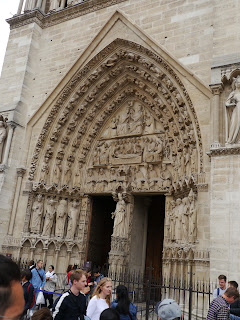 The third door is Mary's Gate. When it was built the church was nearly 1,000 years old. Women were starting to be included in the stories. There were many powerful women in those days. Also in this archway Emperor Constantine is represented because he became a Christian. St. Denis is represented in this doorway holding his head. It is in the Flamboyant style.


We stepped back to look at the church more as a whole. We talked about the history of church. In the beginning of the 1800's the building was in ruins. In 1831 Victor Hugo was commissioned to write a story about the church called Notre Dame de Paris, which is the basis of the Disney movie The Hunchback of Notre Dame. It inspired people and made the building trendy. In the 1840's and 1850's it was renovated. A few decades later during the French Revolution it was destroyed. The line of kings was beheaded. An architect, at great risk to his own life, gathered the fragments and hid them. They were recreated after the war based on drawings and descriptions (no photography in that era). Where there were blanks, he improvised using modern styles. The statues of Adam and Eve have a Classic Greek (and not Gothic) style.
 The chimeras (they are not Gargoyles) did not exist in the Middle Ages. The statues did not exist, therefore Quasimodo could not have talked to them.
Thirty years ago when I was a student in Paris Notre Dame was covered in black grime. It was painstakingly cleaned off, using toothbrushes in some parts.
We walked across the street to see the Cathedral from a different angle. There is a plaque saying on August 19, 1944 the Parisians freed themselves from German occupation. Something they are still (and rightfully) proud to share. Bullet holes are still visible in buildings. Not as many as in Berlin, but something we don't tend to see in the United States.
We received our local information on finding someplace to eat. We were told NOT to go to the 1387 restaurant (now closed) basis of the musical Sweeney Todd where dogs were turned into food, and the barber cut the throats of his customers to steal their money then sold their flesh as meat in his restaurant. This was during the Hundred Years' War when cannibalism was done to live. There is no proof, but the story persists.
We talked about the Vikings. A subject I know a little bit about thanks to our trip to Sweden the month earlier. The Vikings were famous for being enormous fighters, when they were ordinary-sized looters. The losers wrote the history in this case. The Vikings were fighting the Parisians, until the Parisians encouraged them to go south to Normandy.
 The spire is 96 meters tall. The original plan by architect Viollet-le-Duc called for two spires. Le Duc really wanted his image preserved for all eternity as a statue on Notre Dame. He was refused, but if you look closely towards the top of Notre Dame you see a figure in green looking at the spire while everyone else is looking at Paris. It is rumored that le Duc put himself into the architecture anyway. He claimed it was really St. (Doubting) Thomas, but it evidently bears an uncanny resemblance to le Duc's face.

I found more notes about Notre Dame. The Gothic style was invented in France. The pointed window style is symbolic of pointing to God, but it is also more stable. It shifts the weight along the walls, therefore the walls can be higher, keeping with the Gothic quest for height. The walls are 80% stained glass. The flying buttresses give the cathedral stability, as well as looking cool. These are some of the first flying buttresses in the world.
Ile de la Cite (where Notre Dame is located) used to be one of the most crowded places to live. Parisians used iron in their brideges and buildings (think of the Eiffel Tower) to save space.
There are two rose windows inside. The one on the North tells the story of the New Testament (N=New). The ones on the South tell the story of the Old Testament. This was done because at the time 90% of the population was illiterate, plus masses were told in Latin. This was a way to continue the faith traditions of the bible and the saints from father to sons. Life revolved around religion. People celebrated their Saint Day (some still do). If I were Catholic (I'm Presbyterian) a quick google search does not bring up a cool saint for my birthday. I've never heard of the dozen or so choices.
The Gothic Cathedral was viewed as a pure act of faith and gave a reason to believe in God. Take that sentiment with a grain of salt.
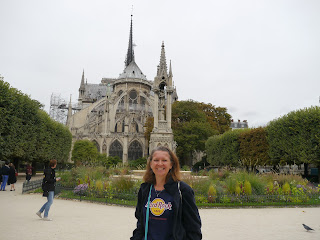
There I am with Notre Dame de Paris behind me. I wearing my Notre Dame de Lawrenceville jacket. I had nice weather on this trip, but September in Paris still calls for a jacket.
Some interior pictures (not part of the tour):
 |
| A history lesson |
During the Marais tour when Florent, our guide, was asked which was his favorite tour, he said the Marais tour we were on, and the Montmartre Tour is also a favorite. When most people think of Montmartre, Sacre Coeur Basilica comes to mind. The area was made famous in the movie Amelie, Don's favorite movie that was turned into a so-so Broadway show and for the artists who used to live there, including Picasso and Van Gogh.
When I arrived at the Blanche metro station (named because the area was white (blanche in French) due to the stones carried to make plaster) for the 5 PM tour I found not one, but two hot pink vested guides: Florent and Matthieu. We were divided into two groups and I stuck with Florent. He noted the giant windmill in front of the Moulin Rouge was spinning, therefore it must be nighttime already. We still had about 90 minutes of daylight.
The artists took over the area in the late 1800's and early 1900's. Life was cheaper in this area at the time. It wasn't part of Paris proper until 1860, a distinction they still maintain in their hearts. Twenty villages combined to make Paris (today there are 20 arrondisments, not sure if the numbers are a coincidence). Paris was surrounded by a wall. Montmartre was outside the wall, and therefore did not have to pay taxes. If you look at a current metro map, from 1783-1860 Paris was divided roughly around Line 2 and Line 6 of the metro.
Being situated on a hill, the area was famous for its windmills. Windmills were
used to crush grapes, wheat, and stones. The Moulin Rouge literally means the Red Windmill (French and English put the descriptive words in the opposite order, the Windmill Red, if you prefer). In the day they had a concert and ball every night. It opened in 1889 and was the first electrified building in Paris. All of their shows start with the letter F, it is a superstition. The current show is Feerie (Fairy). Today their shows are between Broadway and Vegas in style.

 The second windmill on the tour was Le Deux Moulins (the two windmills), the scene of much of the action in the movie Amelie. It was filmed here. Had Don been with me I would have gone in and ordered a tea, but instead after the tour I pressed on with my day.
Florent points out some street art on a building. "Two days ago they painted over a Coca-Cola ad." Graffiti is not allowed in Paris, but "art that takes awhile to make is okay." I seem to recall him mentioning another rule where if owners complain about street art within two days, the city will clean it off for free.
We passed the spot where Vincent Van Gogh lived from 1886 to 1888. It is mighty unassuming today. We also passed a classic 2 HP Citroen, which reminded me of the Trabi cars we saw in Berlin. Brought back memories of when I lived there in the 1990's and there were more of them.
As with most Discover Walk tours, we passed an award winning eatery, this time Le Grenier a Pain, a baguette shop that won the Savoir Faire de Qualite award in 2010 and 2015, meaning they were chosen as the best baguette shop in all of Paris and delivered fresh baguettes to the French president daily. Unlike Marie, we did not all go in and get baguettes (though at least one person did). The croissant is actually of Austrian origin and not French origin. The pastry was created in the shape of a crescent (the symbol of Turkey) to represent their victory over Turkey in the Siege of Vienna.

We were told the best free place to get a nice view of Paris is the eighth floor of Galleries Lafayette. Tuck that away for next time since I did not visit that part of Paris on this trip.
Le Bateau Lavoir (the Laundry Boat) is next door to where the famous Impressionist and Cubists artists had their studios. Picasso's studio burned down. The remaining ateliers around the corner on rue d'Orchampt have large windows in the roof to allow for extra sunlight. They face the north side to provide the most stable lighting.
Across the street is another Wallace Fountain (as seen on the Left Bank Tour I took the day before). Wallace had them installed in 1872, one year after the Franco-Prussian War when Parisians were besieged by the Prussians for five months and the Prussians destroyed the aqueducts. By the end of the war wine was cheaper than water. Sir Richard Wallace had 60 fountains installed to ensure Parisians would always have water. The shape of the fountain prevents horses and dogs from being able to drink out of them. They are still viable fountains, and part of Parisian culture.

On the same street is where Dalida lived. Before this tour, I had not heard about Dalida, but she is a very famous singer from Egypt who lived in Montmartre for the last 25 years of her life and is a highlight of the tour. Tradition has it if you rub the statue of Dalida you will have good luck. I can't believe I did not take a picture of her statue. HERE is a link to it. Yes, I did rub her, but I'm not sure I can attribute anything to her as good luck, like I could with rubbing the toe of the statue in St. Petersburg, Russia.
The Moulin de la Galette is the third windmill (moulin) on this tour. It is a restaurant that was habituated by famous Impressionist painters, including Renoir who painted the Bal du Moulin de la Galette based on this business. It is believed a smaller version of this painting in a private collection in Switzerland. The original is in the Musee d'Orsay in Paris.
The windmill was a symbol of Paris.
Our tour led us to a park where boules were being played. Inside the park is a statue of a headless man, St. Denis. St. Denis was beheaded in 257 AD. After he was killed he picked up his head and ran with it for about five kilometers (3.1 miles) up the hill now known as Montmartre (the hill of martyrs). I learned about him again the next day on my tour of Notre Dame Cathedral because he is immortalized there, too.
The pink house is La Maison Rose. The house didn't used to be pink, but an Impressionist artist painted it in pink in his art and people kept asking about it. Finally the owner relented and painted his restaurant pink.
Across the street is a vineyard. In the late 1800's the hill was covered in grapevines, today there is only a small vineyard with great northern exposure.
In the same area is Au Lapin Agile, the agile rabbit, a famous cabaret that opened in 1860 and is still in operation as the smallest cabaret in Paris. It is on a list of the 1,000 Places You Should See Before You Die. I just requested the book from the library to see how I am doing. In its heyday Picasso, Louis Armstrong, and Einstein all went there. Sometimes artists could not afford their bills and paid in paintings, some of which are worth quite a lot today.
Around the corner is a jungle. A literal jungle. Gardeners are forbidden from entering this wild zone. The city of Paris bought the Saint Vincent Wild Garden and left it as a sauvage jardin for the wildlife to enjoy. It is open to the public and there are guided tours from April 1 through October 31.

From there we ended up at the back side of Sacre Coeur, the quiet side mostly only frequented by locals. Though our entire tour was uphill, it did not seem onerous because instead of taking the giant stairs in the front, we meandered through the area pausing to look at hidden treasures as identified by our local tour guide (one of the specialties of this tour group).
 Sacre Coeur, like most churches in Paris, is free and open to the public. Inside this Byzantine-style church the largest mosaic in France. It reminded me of our trip to St. Petersburg and our tour of the Church of the Spilled Blood. I read the material they used to create the church is self-cleaning so unlike many other monuments, this one will always stay white. Though Sacre Coeur is an iconic image of Paris, it is only 99 years old today (consecrated on October 16, 1919). It costs six euros to climb to the top. It was a sunny day, nearing sunset, so I paid the admission price and climbed the dome. There were only a few people doing the same, just enough that I could find people to take pictures of me, but not so many they were in my way.
Inside is a 19-ton bell that took dozens of horses to carry to the top of the hill.
After my climb I descended using the stairs made famous in Amelie. I passed a fruit stand and thought of the character Lucien who works for his father's produce stand. I then strolled through Places des Tertres where the artists sell their paintings. Ashley is a fabulous artist whose work is adorning our walls, so I did not purchase any artwork on this trip. The square felt smaller and filled with more restaurants than I remember from my 1989 trip before I met Don.
I passed Les Deux Moulins again, hopped on the metro, and went to the Hard Rock Cafe in Paris where I did not purchase a thing. Amazing how Hard Rock Cafe merchandise tends to look the same the world over. I'm happy with my shirt from St. Petersburg.
Here are some images from inside Sacre Coeur and the views climbing up to and through the dome.
 |
| Place des Tertres |

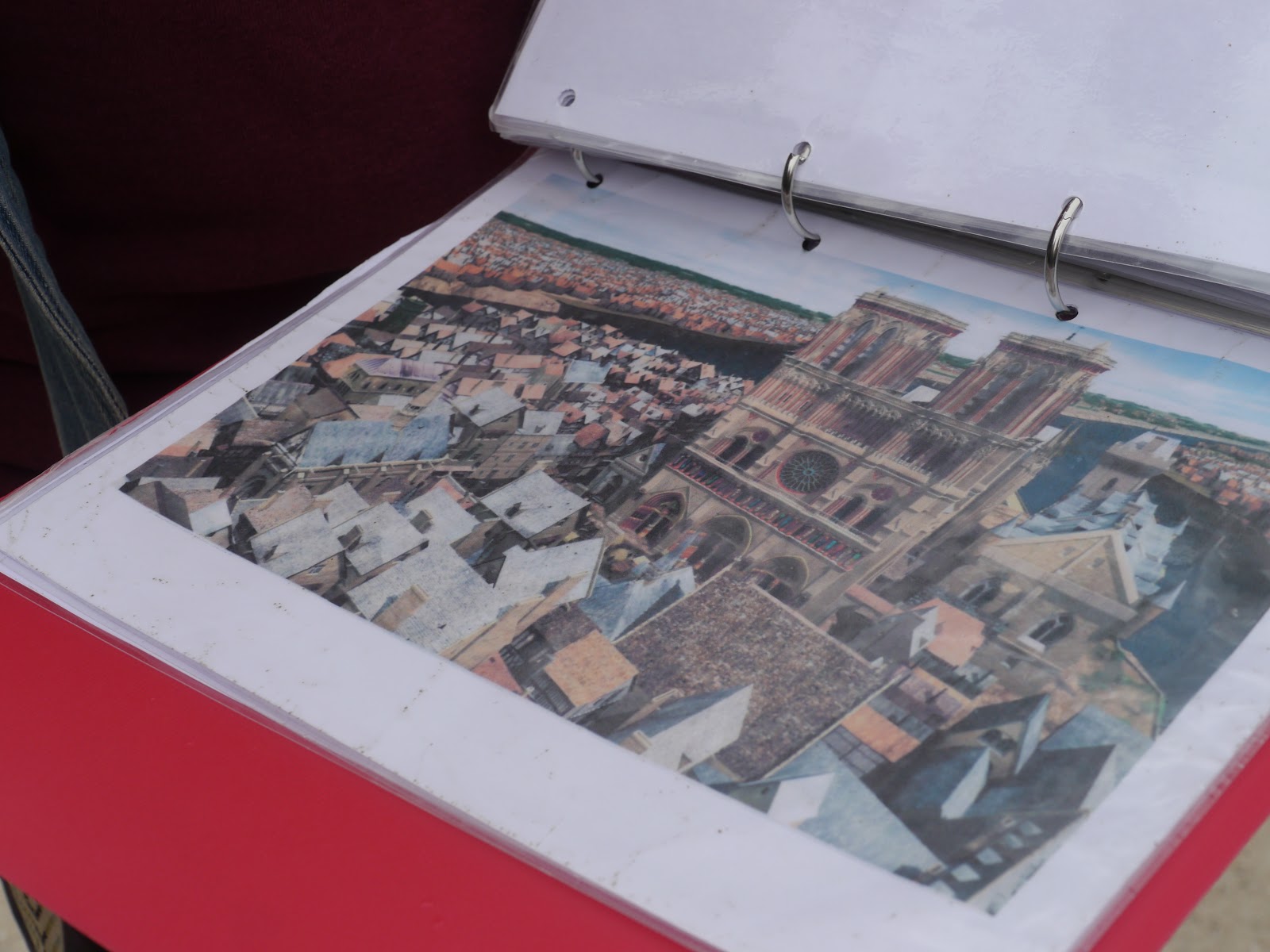

 Back to the doors. There are three of them. The one on the right (when looking at the cathedral) is the plainest. It is also the earliest one. The statues are from ancient times and told stories people knew in that time. Many people were not
  We spent a lot of time looking at the center doors as they are currently not used regularly. They are very ornate. Jesus is in the center (just below the arch) and is opening the graves on judgement day. The angels are blowing trumpets. The belief in the Middle Ages was everyone waited until the end of time "and all the dead shall wake up to face judgment together." Individuality was not a concept, unlike today where Christians believe we go to heaven as soon as we die. Four architects worked on this door. The left side represents people going up to paradise. On the left people are going to Hell (if you are that interested, I trust you can find better close up images). In the middle is St. Michael. Jesus is above all sitting on the throne. When this was built, Jesus's and his blood were in Paris. The relics were destroyed during the French Revolution. The crown of thorns is still here and is visible on the first Friday of every month. Above Jesus is heaven with the saints.
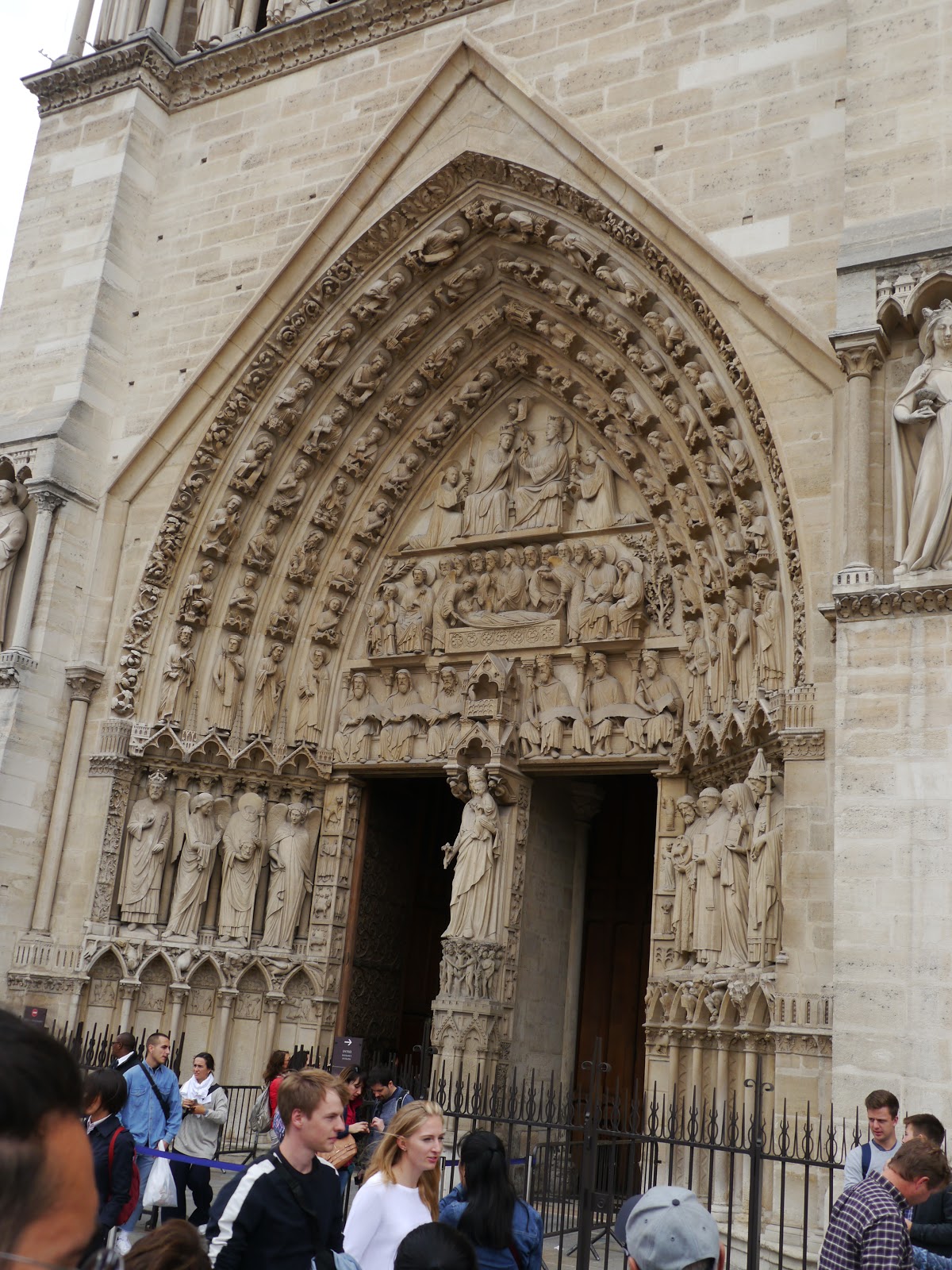 The third door is Mary's Gate. When it was built the church was nearly 1,000 years old. Women were starting to be included in the stories. There were many powerful women in those days. Also in this archway Emperor Constantine is represented because he became a Christian. St. Denis is represented in this doorway holding his head. It is in the Flamboyant style.

 The chimeras (they are not Gargoyles) did not exist in the Middle Ages. The statues did not exist, therefore Quasimodo could not have talked to them.
  The spire is 96 meters tall. The original plan by architect Viollet-le-Duc called for two spires. Le Duc really wanted his image preserved for all eternity as a statue on Notre Dame. He was refused, but if you look closely towards the top of Notre Dame you see a figure in green looking at the spire while everyone else is looking at Paris. It is rumored that le Duc put himself into the architecture anyway. He claimed it was really St. (Doubting) Thomas, but it evidently bears an uncanny resemblance to le Duc's face.


