Pages

Monday, September 3, 2018

Day at Sea

Our nine-day cruise included two days at sea. That sounded both relaxing and wasteful. On the one hand, my notes show I did not wake up until 10 AM that day, mind you we did lose an hour so it was really 9 AM. On the other hand, they could have found someplace for us to visit. Right?

My plan was to type up my notes from the trip so I wouldn't be doing that after I get home, and so they would still be fresh in my mind. My ten-year old Duo (smaller and sturdier than my laptop) had other ideas. I haven't used it much in the past five years. I couldn't even get it to turn on.

I already had written notes, so no reason to do that.

The other part of my plan was to run 10 miles on the 1/8 of a mile track as people sunbathed. I met Rachel, who was doing the same. Rachel was traveling with her 93-year old grandmother and her sister. Unfortunately our paths did not cross again. I had a couple of 4-year old cheerleaders for a while who made me feel like a rock star. Still more exciting than doing the same on a treadmill.


Omelet station for breakfast 
After the run, and after cleaning up, I went into the Garden Grill Cafe --the buffet opened most of the day. I was shocked to see the place was packed at 3 PM. People were camped out.

That night we ate dinner in the Manhattan Room -- one of only a few places requiring people to dress up (polos and khakis for men, dresses and skirts for women, kids could wear "nice" shorts). 

Afterwards we saw "Burn the Floor," their Broadway-style show. Guess I am a bit jaded, but it was nowhere near Broadway quality. Just bill it as lots of dancing and be done with it.

First Port of Call: Warnemunde (Berlin), Part 4

Overall our time in Berlin was only about six hours. We packed a lot into those six hours. Our New Years Eve 1990 trip was not much longer, but it did include an overnight stay in a hotel. What I remember most about that trip is getting an all-day bus pass and hopping on the first bus we saw, which happened to be Bus 1. Bus 1 took us past all of the famous tourist sites in East Berlin and West Berlin, including many we saw on this trip. We also ate lunch in a restaurant called The Berliner Ratskeller, mostly remembered because its name was the same as the bar/restaurant at Trenton State College. Had we been left on our own this day, we would have done much the same and enjoyed it at a slower pace. We would not have learned as much, but that is okay, too. Unlike St. Petersburg (our third port of call), Berlin is a place I could see us visiting again someday.

We left the Spree River area with the Berlin Cathedral and Museums (none of which we had time to enter) and drove deep into the former-East Berlin. Here the roads are narrower. In 1990 all of the buildings were in the Soviet concrete-block style, or a shell. Today there is a blend of old with new. 

We saw Alexanderplatz, called "Alex" by the locals. In the 19th century it was a military parade route. It was destroyed in World War II. In the 1960's the Soviets rebuilt it. Today is is the largest pedestrian square in Berlin with shopping and cinemas and is the heart and soul of East Berlin.

The Spree River has always been important to Berlin. It is the path to the Habel River, Elba River, the North Sea, and the Baltic Sea. That is why Berlin became such a hub during the Prussian Empire.

Jim, our tour guide, gave us a quick summary about the differences between East Germany and West Germany. Still today the five states that made up the former East Germany have the highest unemployment rate -- 12.5% versus 4.6% overall in Germany. There is a mandatory reunification tax of up to 1.5% of income to fix the problems, but many (especially in the "West") wonder why they still have to pay it.

Onto another highlight for us: Checkpoint Charlie. 

During the Cold War there were eight entrance points between the east and the west using the Foxtrot Alphabet: Alpha, Bravo, Charlie, etc. Checkpoint Charlie was the third one. For a while after the division, people could get a pass and easily travel from their house to work and back again through the border crossings. West Berliners could take a train or a car to go between the two. East Berliners had their pass. Who you were and why you needed to cross determined which checkpoint you used -- not necessarily the most convenient or closest one. Checkpoint Charlie was the one for non-Germans (foreigners). The Allies used this crossing. 

Between 1945 and 1990 the chief power was the military. Near Checkpoint Charlie there was a large American presence. Everything we saw on this trip was a replica, a "Hollywood set" if you will. I have a pretty bad picture of what we saw in 1990. It looked a lot different.


Yes, that is a Kentucky Fried Chicken restaurant near Checkpoint Charlie.
This was another moment when my eyes popped out of my head. The first was at Brandenburg Gate earlier in the day. The spookily quiet spot has grown into the most Americanized spot in all of Berlin, and likely all of Germany.

In this section is the Checkpoint Charlie Museum -- a highlight of our 1990 visit. It is a chilling example of the efforts people will make to be free. Of course we did not have enough time to go inside it on this trip.

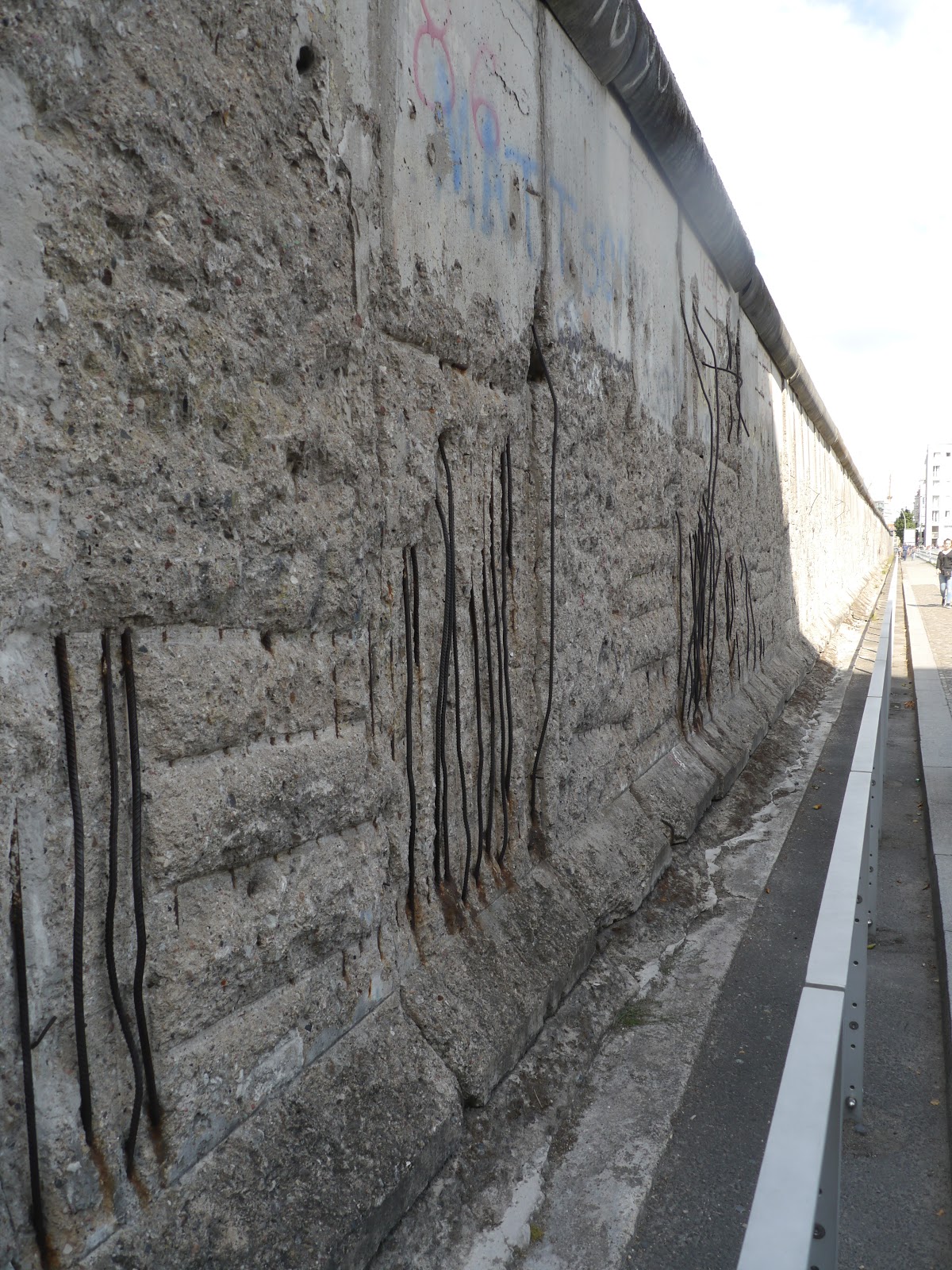
A question I have wondered was how did the Allies allow a wall to be built on the border between the two sides. The answer is instead of building the 100-mile wall exactly on the border, the Soviets built it in a few feet -- clearly on their side of the property, thus giving a little bit to the Allies. They could do what they wanted on their land. Technically people were on East German property when they touched the wall.


At this point Don sees a Trabi car -- the most common car in East Germany during the Cold War. His eyes light up in excitement. The tour guide is less excited. A block away is a shop where you can rent one of these. During the Cold War there was a 15-year wait list to own a new one, the ultimate status symbol of its day. It is a 2-cylinder car that makes my former 3-cylinder Geo Metro seem powerful. Even in 2018 these Trebis still break down a lot.


We walked a block to The Wall. In 1990 Don and I stood by the Brandenburg gate and asked about The Wall. The tongue-in-cheek response from a guard was "Wall, what wall?" My photos show we did see a couple of pieces of The Wall, but not a long, intact stretch.

Turns out there is a stretch of wall that has been preserved in its original location only a couple of blocks away from Checkpoint Charlie.

Doing a little bit of quick research thanks to Google, this area known as the Topography of Terror did not exist in this form in 1990, though this stretch of wall was likely standing at that time. It was designed in 1993. Construction was begun in 1997 and halted in 1999 because of costs. 

The history of this East Berlin site dates back to 1987 when there was an East Berlin. In honor of the 750th anniversary of Germany, a temporary exhibit was built on this site called "Topography of Terror. Gestapo, SS, and Reich Security Main Office on the Prinz-Albrecht-Terrain." It was so popular it outlasted its original plan. In February 1989 (a few months before The Wall came down when it seemed nothing would ever change) the Berlin Senate approved a plan to preserve this history.

There is a free museum we did not visit due to time. Instead we stood in awe of the blank wall. What I didn't realize until we were leaving was of course this side was blank -- this was the East German side. The other side (the one facing the street) would have been painted. The painting is not very exciting, but it does exist. Again, I need to figure out how to use our new scanner and include pictures from 1990.

In the end, I am glad we had the guided tour. It did help us to maximize the crazy day, plus it eliminated the stress of "what if" we ran late. As is, we arrived an hour after we planned to (but before the ship was going to sail). No one needs that extra stress on vacation.

All too quickly we were back on the bus and driving three hours to Berlin. For us the six hours of driving for six hours of sightseeing was totally worth it. If we were to do another Baltic Sea Cruise (which I highly doubt) we would stay closer to the boat and explore that area at leisure. It had taken us 28 years to return to Berlin. That is what made this trip special to me.

Sunday, September 2, 2018

First Port of Call: Warnemunde (Berlin), Part 3

Our adventures continued with a stop at the Holocaust Memorial.


The official name (in English) is the Memorial to the Murdered Jews of Europe. Once unification was old news in the 1990s, the world turned to Germany and asked them to come together as a unified city. As our tour guide Jim put it "it was a key moment to do something positive, to confront this history at the national level." The question became, how. In 1999 this park was commissioned and built by Peter Eisenman and officially unveiled on V-E Day in 2005. The location is in the former East Berlin, a block away from the Brandenburg Gate.

The park consists of 2,711 concrete blocks of various lengths and widths. There is no significance to the number 2,711, nor to the sizes. People hang out on the blocks and picnic or soak up the sun (hence a picture of us smiling in the park does not feel out of place as it would in similar memorials, mostly I wanted to give a sense of the scale).

Our guide said to walk around and observe. Try to draw our own conclusions. Walk up and down the uneven terrain. See how people disappear and reappear within the taller sections. No two blocks are the same. There is a chilling feeling as the blocks get taller and easier to hide behind.


Don't you feel enlightened?
There is a free museum underground the memorial, but no time on this tour. 

From here we walked to a parking lot that is said to be the site of the bunker where Adolph Hitler took his own life.

In the backyard of Hitler's office, top Nazis had their offices. In its day, it was a huge 400 meter-long building (over 1300 feet-long). The bunker was built between 1943 and 1945 and attached to an earlier bunker built in the 1930s. It was 30 feet below the earth with 12 1/2 foot thick concrete walls. It held 20 rooms for staff. His wife, Eva Braun (whom he had just married) died a day earlier. There have been several attempts over the years to fully destroy it before they finally turned it into a parking lot.


Long story short (feel free to research the full story), his body was destroyed and there is no final resting place, burial place, or memorial to honor his life. Who would want to?

From the parking lot we walked to the Mall of Berlin, the largest mall in Germany. A place where this Paramus-native felt instantly at home.

One quick note -- while credit cards are ubiquitous throughout Europe, to the extent it was perfectly fine to buy a single postage stamp with a credit card, they are not commonly accepted in Germany. Our first stop was to find an ATM and acquire some Euros so we could buy lunch. This was only two times on the trip we ended up with some local currency. Six different countries (eight including connecting flights) and five separate currencies (including Canada and Switzerland). Only came home with Euros, which I'm sure we will be able to put to use.


Our mission during lunch was to find something to eat in the food court, a postage stamp for my souvenir album (which I will write about and link to at the end), saline solution for Ashley, Don was excited about the Aldi's, and enjoy some free wifi and a bathroom break. Happy to report, we had success all around. Even picked up a few pieces of Lindt chocolate for a mid-afternoon snack.

Time to rejoin the group for the afternoon portion of the tour.


Ultradin Linden
Jim, our tour guide, told us to "use our imagination" as we drove through the old part of Berlin. There are never-ending construction sites. Some places that were gutted by fires are being rebuilt within their old walls. Though it has been nearly 30 years since unification, and over 70 years since the end of World War II, the work continues. Some of the old buildings are receiving new names. There is a nice blend of the old and the new within Berlin. Somehow it works. On Ultradin Linden, normally a beautiful street, it has been torn up since late 2009 as a new subway line is being built. Ahh...progress.


Pink opera house
The bus took us past the 1741 opera house (a pink building) and the 1770's royal library. Between 1740 and 1786 Frederick III turned Berlin into the Prussian royal capital. The architecture is amazing. The current Humbolt University was a palace for Frederick the Great's younger brother, Prince Henry, who died before he could move in. After his widow and her 90-person staff moved out, it became Humbolt University. Today it is the oldest university in Germany. Famous alumni include Albert Einstein.


Royal Library
We passed one of the saddest places for a librarian to see -- Bebelplatz, the square where books were burned immediately after the start of World War II on May 10, 1933 when 20,000 books were taken from libraries and stories and burned. Works by Karl Marx and Albert Einstein (and others) were destroyed. It was the first public attempt to impose the Nazi ideology on German people.

We had a stop at the Berlin Cathedral. When I get the new scanner working I'll add in a picture of what it looked like in 1990. Today it is in the process of being restored to its original glory.

This area is called Museum Island because it has five museums in it. It has been declared a UNESCO World Heritage Site. They are on the grounds of the old city palace, which were opened to the public in 1918. These were built during the time of King Frederick Wilhelm the IV, who enjoyed traveling internationally and brought things back with him. In 1905 King Wilhelm II, a spiritual man, had the cathedral built to show his love to God. It was gutted during World War II.


This park-like setting was paved over in the 1930's and turned into a parade ground so Hitler could strut his stuff. To this day, the war damage is visible in the columns.
The white spots are patches.
The black spots are due to oxidation.

We saw the Berlin Television Tower. At 368 meters (1200 feet) it is the tallest structure in Germany. Its claim to fame in our world is in 1990, Don and I had a snack in the restaurant in the top. We had heard it was torn down, but clearly that was a false rumor. 


We hopped back in the bus and crossed the Spree River again for our final stop: Checkpoint Charlie and The Wall. Along the way Jim shared more facts about German history. 

NEXT

Saturday, September 1, 2018

First Port of Call: Warnemunde (Berlin), Part 2

As stated in Part 1 for the day, our group was split into two. We got to keep the big tour bus. I don't know how the other half traveled. Everyone in our group could have a window seat or two to themselves.

Our driver drove us through the former West Berlin. Up until this point we had been in the former East Berlin. Twenty-eight years ago it took no skill identifying East from West. Now the East is having a building boom and it is not as easy to tell. Jim said a small percentage of the tax everyone pays goes into a fund to rebuild the East. The wounds are strong, and it will take many more years to fade. It would be akin to slavery in the United States in that regard. The wounds are deep.


The problem with drive-by tourism
We passed Charlottenburg Palace, home to the first Prussian queen consort, Sophie Charlotte. Charlottenburg is one of twelve districts in Berlin. Jim described it as a more relaxed, and green part of town, where people tend to move when they retire. It is a "garden colony." 80% of the people live in apartments and get plots of land with tiny houses on it so they can have a "yard." The houses are not habitable, good enough for roughing it, but not for living in.

As Jim talked, I was the dutiful student and took notes. Berlin has 3.5 million people in it (New York City has 8.5 million people). It dates back to the early 13th century. The first written records about the area date it at 1237 when it was a trading post on the Spree River. It was a swampy piece of land. The word Berlin in the Slavic language means swamp. As construction continues to happen, water is being extracted out of the city via ugly temporary pink pipes. Germany had a monarchy from 1701 until 1918 (the end of World War I. At first they were Prussian Kings, and in 1871 they were ruled by German emperors. A royal palace was built in 1706, and lived in until the 20th century. Mind you based on the little bit of research I just did, none of this seems to relate to Charlottenburg Palace, but is still interesting, at least to a history buff like me.

Today the palace is used for cultural events and wedding receptions.


A much better drive-by photo
After World War I, Prussia maintained a democracy until 1933, when Adolph Hitler came into power. He took the royal buildings for himself. 

We passed the 1902 Old City Hall. City Halls later became district halls as the seven different parts of town were unified under the capital in 1920. Today it has a vibrant downtown feel.

Berlin is a sprawling city of 345 miles. New York City is 302.6 square miles. The size of the city became clearer when Jim said the Berlin Wall was 100 miles long. ONE HUNDRED MILES LONG! More about The Wall HERE.


Interesting camera angle, but it works
Jim pointed out you can see the differences between East and West in how they were rebuilt in the 1950s, post World War II. East Berlin focused on rebuilding the subway (which we rode in 1990, after it was going between both sides again), and had narrower roads. West Berlin focused on bus lines and independent car ownership. Today both sides have elevated train tracks, with four S-Bon lines going East and West, a subway system, trams, and streetcars. The mass transit system is so strong there Jim can easily get everywhere by mass transit and does not need a car. A day pass is seven euros, a monthly pass is 60 euros. Students ride for free.

Our next drive by site was the Victory Column celebrating Germany's 1871 unification when they first became their own country, instead of a collection of different duchy. Otto Von Bismark was the architect.

We passed the Bellevue Palace located on the Spree River. Bellevue is the home of the president of Germany, a purely ceremonial position that comes with a great house.

This is near the Tiergarten -- the largest park in Berlin, filled with bike paths and people enjoying them. We did not have time to explore all 529 acres, but we did pop through when we walked from the Parliament Building to the Brandenburg Gate.

The Parliament Building, or Reichstag as it is known in German, has the words
Den Deusher Volke (For the People) on the lintel. I wish we had the time to go inside. The pictures on the Visit Berlin website are amazing, especially from inside the glass dome. 

In 1894 it became the official seat of Parliament, ruling over 40 different lands. The Prussian leader lived a few blocks away. The end of the empire came in 1918, with the end of World War I. The victors wanted more checks and balances in place, and thus was born the Weimar Republic (the unofficially designated name for the time period from 1919 to 1933). This building saw the heaviest fighting in the days leading up to end of World War II (May 21, 1945). Most of the damage took place in the final hours of the war. Jim showed us before and after pictures to accentuate his history lesson.

Post-World War II Germany was divided into four zones: British, French, American, and Soviets. The first three countries got along with each other, the Soviets did not. Berlin was firmly in the Soviet section, but as the capital, it, too was divided into
four zones. In 1949 the country was divided into two states: East Germany and West Germany. The three allies merged to form West Germany and the capital of West Germany was moved to Bonn. The communists ruled East Germany. West Berlin was was "an island of democracy in a sea of communism," as Jim so eloquently put it. In the 1980s this building became a history museum. In 1991 (after The Wall came down), the main seat of government was moved here. Twenty-five years ago, there was nothing in this area. Off to the side in the white building is the Federal Chancellery Building where Angela Merkel (the Chancellor of Germany) works. Jim said she "lives among the people."

We took a stroll through the park to Brandenburg Gate.

A little bit of the history of the meteoric rise of Adolph Hitler. In 1933 there was a move to oust democracy. A week before the election there was a fire, and all 81 communists in power were arrested, those anti-government were also arrested for being "involved." The events all fell into place for Hitler to win power. The fire accelerated the speed at which it happened.

In the park is a fairly new memorial to those persecuted during World War II, including gypsies, those subjected to medical atrocities, victims of concentration camps. It was hard to take a picture. There is a separate Holocaust Memorial we went to later in the day.

If you read our first post, you read Don and I had a quick visit to Berlin on New Years Eve 1990 when I was studying abroad in Paris.

This is our view from 1990:


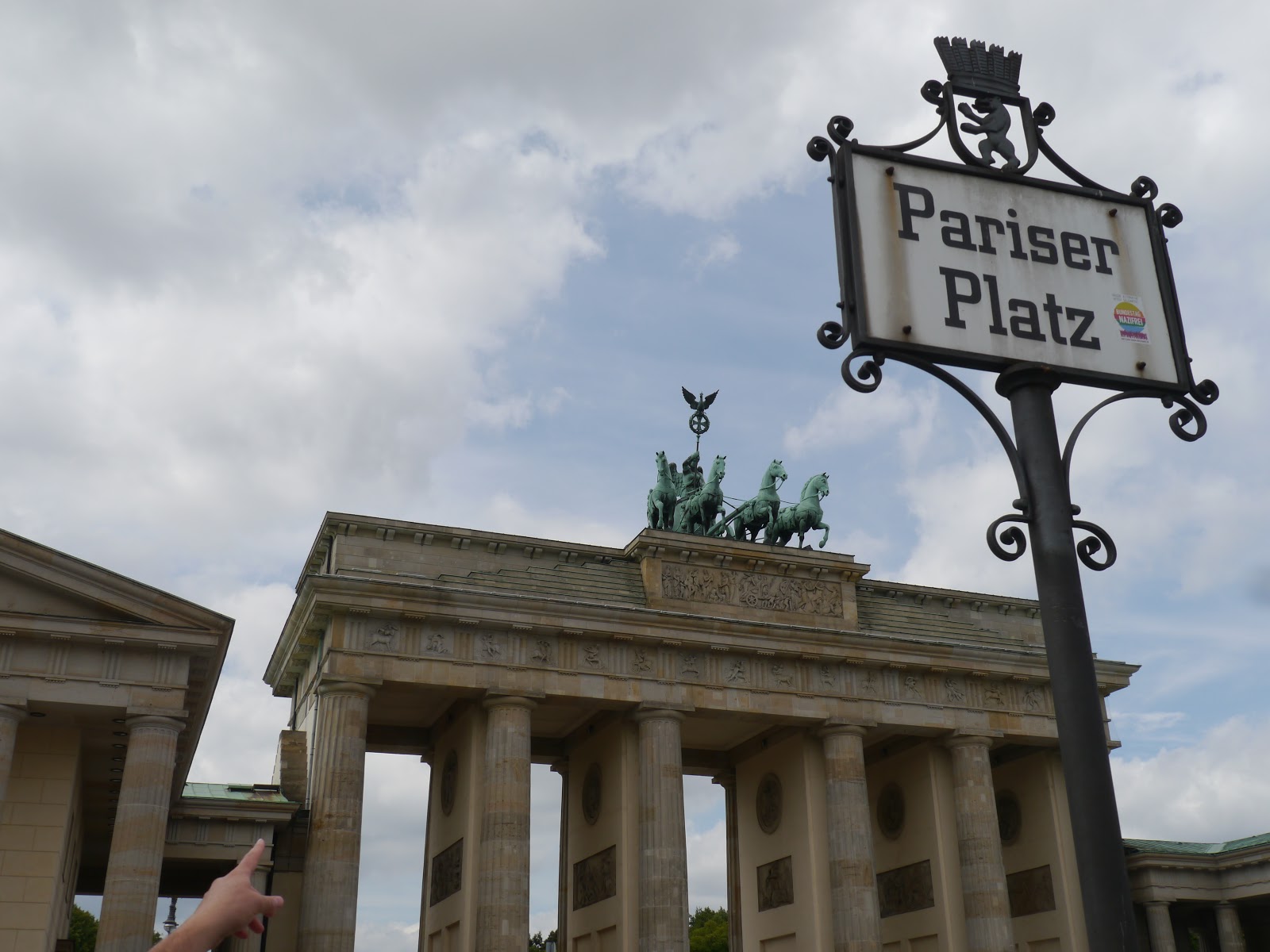
And the view from last month:

This was a jaw dropping moment for me. I should have looked at our old photo album before leaving, and even brought a picture to compare on the spot. In 1990 the Place de Paris was empty. I did not take pictures of it (I was using a disc camera in those days and photography was expensive, the quality was stinky). 

Looking the two pictures, it is immediately clear the top one is lacking the statue Napoleon took to Paris in the 19th century (hence the name Pariser Platz). It has since been cleaned up, and a bunch of buildings surround the square -- including the American Embassy. It was a marvelous sight to see. All this happened in the past 25 years.


Jim's hand


American Embassy back in its original location


When the wall went up, three million East Germans moved to the West, leaving behind only 20% of the East German population. To stop the rest from leaving, they blockaded the border and put a 100-mile concrete wall through the center of town. This was how they lived from 1961 to 1989. As Jim was recalling the history I could hear Ronald Reagan's voice in my head: "Mr. Gorbachev, tear down this wall!" Goose bumps. Today a cobblestone path indicates where the wall had been. In 1990, when we asked a guard where the wall had been, the eye-rolling response we received was "Wall, what Wall?"

Brandenburg Gate was named as such because in 1791 it was the gate (out of 18 gates throughout the city) that led to Brandenburg, a city now less than an hour from Berlin.

In the 19th century Napoleon moved the horse from the top of the Brandenburg Gate to Paris. In the early 20th century there was a push to restore this area, the symbol of division. In 2003 the French Embassy returned. In 2008 the American Embassy moved back. 

During World War II, 70% of the center of Berlin was destroyed, 80% of Berlin was destroyed by the 68,000 bombs that landed in the city. The area post-1945 was desolate. In the 1950s, the park was rebuilt as East Berlin and West Berlin rebuilt.

Today it is a thriving metropolis.


NEXT

First Port of Call: Warnemunde (Berlin), Part 1

Our first port of call was also our first full day of the cruise. The options: staying close to the boat and exploring Warnemunde, Germany or take a three-hour bus ride each way to Berlin, Germany. Fans of the Pillsbury Press can guess the answer -- an all-day excursion to Berlin, of course.

On New Years Eve in 1990 Don and I went to East and West Berlin for an overnight trip. I was studying at the University of Paris, and history had been made barely a year earlier when The Wall came down. We knew it was a now or never moment. Twenty-eight years later we were about to return to see how it evolved.

Here is a link to a stranger's blog post about how Warnemunde is an awesome day trip. I'm putting it out there in case you are ever in the position of choosing your own Port of Call Adventure. I'm glad we did what we did, but if we were in a similar position in a few years, I would stay in Warnemunde.

Due to its distance from Berlin (billed as a two-and-a-half hour bus ride, really over three hours), we were told by our travel agent we had to book the excursion through the Cruise Ship, or else run the risk of literally missing the boat. The agreement was if we booked through Norwegian Cruise Lines and our return was delayed (for example: a traffic jam or mechanical failure) they would hold the boat for us. If we had a similar issue with a different tour group, they would not. Talk about having a monopoly!

Deep breaths. Okay, we signed up with SPB Tour. What I really wanted was what our friends Kim and John did last September -- have the tour company drop us off in the middle of town with the promise we would meet up with them again at the designated time. Unfortunately (or so I thought at the time) I did not see that option on the approved list.

Instead we had a tour. I detest tours. Tours always move at the pace of the slowest person. Tours always include lots of time to buy souvenirs, but not enough time to sight see. Tours are boring. I could do it better with my Lonely Planet book. Yadda yadda yadda. I was not looking forward to the tour.

Started off we were told the tour would have no more than 24 people. There were more than that on our bus. I was not a happy camper, but <<deep breaths>> we WILL have a good time! 

When we arrived in Berlin our tour group of about 36 people was split in half. We only had 18 people who moved at a similar pace as we did. Mind you, I was also taking a lot of pictures and making lots of notes, both of which helped slow me down. Both of which also helped me to keep my sanity.

Our first stop, with the exception of a bathroom break midway on the drive, was at the Olympic Stadium. The one made famous by Jesse Owens in the 1936 Olympics. The one currently being used for a huge high school-level sporting event. The same event that made it impossible for us to get to our next stop: The Kaiser-Wilhelm Memorial Church. Follow the link to learn about it on your own. It is a church that was burned out during World War II (which really does not narrow it down much), one we did see 28 years earlier. Having been on the other end of races -- with roads shut down for me and my fellow athletes -- I cut them some slack. In the end, I think it made for a more relaxed pace as we were not rushed.

Our tour guide was Jim from Minnesota. Jim moved to Berlin 13 years ago to be a college student. He fell in love, got married, and had a family. He spoke at the perfect mid-west pace -- slow enough to take notes and repeating just the right amount. He brought pictures of how places looked over the years (pre-World War II, post-World War II, 1989, etc.). I learned so much from him.

Back to the Olympic Stadium and a rare picture of the three of us.

The stadium was built in anticipation of the 1916 Olympic Games. A slight expansion was planned in 1931 (in anticipation of the 1936 games). Two years later the Nazis wanted to send a message and built an even bigger stadium. At one point the stadium held 110,000 people (2002 renovations with new seating have shrunk that number to a mere 74,500 seats. By comparison, Yankee Stadium has 54,521 seats, the Met Life Stadium in East Rutherford, NJ has 82,500 seats). 

Jim pointed out the bullet holes still in the stadium from when Berlin suffered TWELVE DAYS of hand-to-hand combat near the end of the war. Throughout the tour we were gently reminded about these twelve days. I cannot imagine living in a war zone.

At the moment, though, the highlight was the free (clean) public bathroom. Denmark had many places for clean, free pees, but in Germany we had already encountered one bathroom lady (and had zero Euros on us at the time -- there will be another post about the various foreign currencies), so a free trip to the bathroom is worth taking.

Back in the bus to go inside Berlin.

Norwegian Cruise Lines

With the exception of a two-day cruise to nowhere in 2012, our cruise in the Baltic Sea was our first cruising experience. Looking back at past Pillsbury Press posts (say that three times fast), I did not even blog about the Disney Cruise we took out of New York City, which does surprise me, it was a pretty miserable experience in that the 37 hour cruise was billed as a three-day cruise -- we boarded the boat at 5 PM on Friday afternoon and had to be off by 6 AM on Sunday morning. We spent more time sleeping than anything else on that cruise. It definitely turned us off to future cruises.

There are pros and cons to cruising. In our case, we wanted to see certain places without having to lug our suitcase, check into different hotels, worry about pickpockets as we tried to catch sleep on trains ... basically I wanted a floating hotel room. And that is how I approached our voyage.

The ship (Norwegian Breakaway) was HUGE -- 16 floors huge. It was built in 2013 and refurbished in 2018, though it did not feel that new to me. There were 3,983 passengers (at capacity) and 1,500 staff members. Our room steward, Roma, had nine rooms to tend. Our room was in the center of the 9th floor, near the Aft staircase. A good location for us since most of what we wanted to do was on the Aft side, such as the buffet and running track. We easily managed to get our 10,000 steps a day, even while on board.

Our room was much larger than we expected. It helped I took the advice of our travel agent and upgraded from an inside room with a bunk bed and twin to this spacious room with a balcony. The couch (close to the window) converted into a bed for Ashley. It stayed a bed the entire cruise.


My favorite feature was the library. I didn't spend nearly enough time in this sixth floor gem.


Ashley's favorite part of cruising was being able to order her meals the night before to ensure they would be dairy-free. She loved being able to eat without worrying about butter being added to vegetables, or some other hidden dairy that would flare up and make her sick later. She also loved the early morning yoga stretch sessions.

I did not like the captain waking me up every time I tried to take a nap. Sightseeing is tiring work. So is staying up late most nights because, well, we were on vacation and because it was only dark between 11 PM and 2 AM that time of year.

There were an overwhelming amount of activities to do, but my favorite was walking and running the track. It is an eighth of a mile. My training schedule called for an 11 mile run. I met a woman training to qualify for Boston who did a 20-mile run on the track -- or 160 laps. The track's measurements seemed off. 

Running on the track was both annoying and amusing at the same time. There were people who would stand on either side of the track taking pictures of each other as we ran past. The runners faster than me were passing the same spot once a minute. There were a bunch of us running. I tried to explain to them if they walked down about 15 feet, they could take the same picture of them with the Baltic Sea behind them, but without people running in their picture, but they knew best (or didn't understand English, or were lazy). The track also intersected with the main entrance to that part of the boat, so people would step on the track and try to figure out if they should go left or right, since straight put them in the climbing rock wall.

After dinner we'd watch the sun set around 10:30 PM. Wake up early the next day to do it all again in a new city.


The one disappointment I did have with the cruise was how early we would have to be back in the ship in order to start our adventures for the day. I would have liked being able to stay in port and have dinner or see a city at night. 

Spoiler alert ... of all the ports we visited, Stockholm is the only one we really want to return to as an extended trip. That was our last port. Many blog posts to write and read between now and then.

Past Couple of Weeks

The past couple of weeks have been insane. They have flown by in a blink of an eye, yet dragged on at the same time.

Since our return from Copenhagen:

August 20 -- Landed
August 21 -- Carin died, had job interview with Dressed for Success
August 22 -- Power weeding, figuring out the funeral plans, book club at our house, cold caught on flight home
August 23 -- Carin's funeral
August 24 -- "Quiet" day, Ashley had a friend over, ending in food poisoning
August 25 -- In bed all day with food poisoning, except when contractor needed me to tell him where to trim the trees
August 26 -- Felt human again, went to church.
August 27 -- Interview with Princeton University for a temp job; baby shower at volunteer place; found out I landed the job at the University and will start in two days
August 28 -- Saw "Frozen" on Broadway
August 29 -- Started the temp job at Princeton University
August 30 -- Ashley's first day as a Junior; Ashley's first self-defense class
August 31 -- Car died on the way to work; Don and Ashley had day off; Don took my car to mechanic; I took him to train station; I picked him up at the end of the day

Now it is September. As I sit here and type, I wonder what this month will throw at me and how I will handle it. With grace? Hopefully. Kicking and screaming? Hopefully not. 

Enjoy your September.