Pages

Showing posts with label history. Show all posts

Friday, June 21, 2013

Osaka, Japan

We are now at the half-way point of our trip. We've spent a night on the airplane, four nights at the hotel near Tokyo Disney, a night in Nikko, a night in Tokyo and we are about to crash for the night in Osaka.


Each day continues to bring new adventures. Today I figured out how to use a machine without pictures or words in English to order lunch. I had curry chicken udon suki (noodles and meat in a rich broth served in a ceramic stew pot). I think the traditional version should have had buckwheat noodles, but I had one with regular noodles instead. Even our friends were impressed with my ability to order from the machine.


My other accomplishment was buying train tickets using a vending machine. For this there was a button to switch to English (much to the amazement of our friends, it looked like a magic trick), and the friends told me which station we were going to and how much money the machine wanted.


Osaka is the most American-style town we are going to, even though it is still mostly in Japanese. The biggest difference is here when using the escalator or stairs, the crowd stays RIGHT instead of LEFT. It was enough of a change to make me a little more comfortable getting navigating the area.

Since we opted to leave after rush hour rather than get another super early start, we did not arrive in Osaka until 1:30. A little more planning and we should have bought sandwiches in Tokyo to eat on the train. By the time we checked into the room and had lunch, it was after 3:30. 


We took a subway to Osaka Castle. We were having so much fun taking pictures and meandering that we nearly missed going inside the castle. The castle will be celebrating its 400th anniversary next year (or rather the 400th anniversary of the death of Toyotomi Hashiba). The castle looks like a 5-tiered wedding cake on the outside. Inside is filled with Hashiba’s rags to riches story that led to the building of the first Osaka Castle. The first one was struck by lightning and burned to the ground in 1665. Thanks to a giant public effort, it was rebuilt in 1931. Two years ago they celebrated their 80th anniversary of the current building. Osaka Castle reminds me of Disney in that way – always a reason to celebrate.

Throughout the day it rained on and off. The word on the street is that the typhoon is still headed our way. Weather.com says it will rain all night tonight and only have a 10% chance of rain tomorrow. That would be ideal.

We heard the magic “go home” music of Auld Lang Syne, which makes us think of New Year’s Eve. They very efficiently and effectively kicked us all out of the 8 story building.

Given how overcast it is, we decided to postpone our plans to see the Floating Garden in the hope that it will be clearer tomorrow night (it is in a really tall building in Osaka). We took a leisurely stroll all around the castle and bumped into people setting up a water station for a race. This was one of many times I wished I spoke Japanese. The translation was not proceeding the way it could have because our friends do not speak race lingo. The best I could determine, there was a 5K and a 10K race that started at 7 PM as it was
getting dark. I think (understanding races) the 10K started first, the 5K started later? Or else we saw the 10K people finishing around the 40 minute mark. I just don’t know and a quick Google search did not find the race. Before I left the States a friend encouraged me to search for a small local race. I didn’t. I even left my sneakers back in Tokyo. It would have been fun, but it would have tied up most of our time in Osaka. Fortunately I did not see any finishers’ medals, or else I would have really been kicking myself.


For dinner we tried a local specialty: okonimiyaki. Basically it is a pancake cooked with meat and vegetables on the table. Ours also had meat in it. Don wants to start making this instead of crepes for brunch on weekends. 

Unfortunately Ashley was not too fond of it, but I bet she would like it with some Nutella and bananas tossed inside of it. The food was originally created in 1700 as a Buddhist ritual food.

This brought us to 9:30 PM and Ashley’s pumpkin time. She is still waking up super early – anywhere between 3 AM and 6 AM. I guess I have a bit of the opposite problem as I’ve enjoyed staying up close to midnight updating the blog, charging electronics and copying pictures to our mini-laptop. Now if only the wifi will stay connected long enough for me to post this.

More pictures of Osaka

Wednesday, January 9, 2013

Dining with Lewis and Clark

Monday night we continued a five-year tradition of attending one of the Cock and Bull Restaurant's Evenings in the Colonial Kitchen series. In 2012 we dined with John and Abigail Adams, and in 2011 it was Oney Judge and Betsy Ross. The year before we celebrated Don's birthday by dining with Ben Franklin and John Hancock. The first year we dined with artists Sarah Miriam Peale, and her uncle Charles Wilson Peale. The first person re-enactors are each member of The American Historical Theatre in Philadelphia.

The Colonial Kitchen series runs on twelve consecutive Monday nights from January through March -- during the slow season for restaurants. From what I gather, the program started around the nation's bicentennial (1976), and has continued ever since. Prices went up about a dollar this year, which I only noticed because last year I made note of the price in this blog. The four-course meal is still quite a deal at $22.95 for adults, and $12.50 for children 10 and under. 

It is a challenge to find the right evening to go. Normally it falls off our radar, only to remember when there are only a couple of weeks to go. We find earlier in the season is better because the restaurant is much quieter and the actors have more time to spend with each table. This was certainly the case this year. A quick note: Lewis and Clark will be returning on March 18, so if you read this and wish you could meet them in person, you still have a chance this year.

Ashley is taking a class at Princeton University's Cotsen Children's Library called Cotsen Critix. The group meets every other Friday to learn about something literary related (a great idea for a future blog). Ashley has an assignment due this week for the class where she is to write a 3-page historical fiction story. She chose to write about Lewis and Clark's expedition from the perspective of Sacajawea's baby, Jean-Baptiste, otherwise known as "Pompey" by the expedition. Pompey was a  couple of months old when the voyage began, and about a year and a half when it ended. There really is not a lot written about his feelings on the voyage.

We used the dinner as an opportunity for her to do some research. That counts as first-person research, right?

Driving to Peddler's Village we talked through some questions: 

  • What was the baby like?
  • What did he eat?
  • Was he a good baby?
  • What was the most exciting part of the trip for you?
  • What do you think the baby liked?
And so on. 

We had no idea what Lewis and Clark would "remember" about their expedition -- after all it did take place over 200 years ago in 1805.

Meriwether Lewis came to our table first. He had the most distinct way of pronouncing Sacajawea's name and the word in-DIE-an. It was charming listening to him. Turns out Lewis was the first person Jean-Baptiste saw since he delivered the baby. Pompeys Pillar in Montana is named after the boy.


After dessert, William Clark came to our table. He told us a lot about Jean-Baptiste's life. Clark educated Jean-Baptiste in St. Louis from the time he was four. Some highlights include Jean Baptiste met a German prince, with whom he traveled all over Europe and Northern Africa--places I have not been to even though travelling is much easier 200 years later. He went to California during the Gold Rush and eventually ended up in the Oregon Territory (the only member of the expedition to do so). There he died from pneumonia at the age of 61. Visit the Lewis and Clark Trail website for more details

I was most impressed just how knowledgeable they are about the life of the baby that was part of their expedition. Based on the snippets I heard of other conversations, they are both extremely knowledgeable about the lives of the men they were portraying. They each spent a lot of time at each table. Clark often sat down at tables to talk at great lengths with guests who wanted to pick his brain.

Ashley left with more than enough information with which to write her story.


Each week at the restaurant Tuckers Tales is on hand to sing songs, play tunes and entertain the diners. This year we had the pleasure of being seated near them. Even though we only see them once a year here, and on occasion someplace else, they remember us and catch us up on the news. A few years earlier we learned that Marianne Tucker shares Don's birthday, so we surprised her by wishing her a happy birthday. It is always a lot of fun hearing them perform. The love they have for each other really comes through, too.

The food is very good, and the entertainment top-notch. Now I'm wondering if we should return for another Colonial Dinner this year before Ashley ages up to the adult price. We still have a lot of people we would like to meet.

Wednesday, August 1, 2012

Quiet Valley Living Historical Farm


With our day trip to Quiet Valley Living History Farm this week, I feel as if Ashley and I are back to day tripping our way through historical sites. Considering it is August already, it is about time.

This trip started out as a Facebook idea. My friend, Michelle, was lamenting that her daughter's field trip was too far away and would not get her home in time for her dance recital later that night. After looking at the place online, I suggested we postpone the trip until the summer and let the girls have a chance to visit together. Another friend, Karin, saw the "conversation" and asked to join the fun outing. 

Three moms, two preteen girls, and two kindergarten(ish) boys had a triple playdate in Stroudsburg, PA. It was nice because for many reasons. The weather cooperated (80, low humidity, and no rain). Plus the kids were all happy because they had a friend to play with, and the moms were thrilled to be able to hold conversations. Oh, we also snuck in a few lessons about farm life in the late 19th century.

The farm was started by the Depper family who escaped from feudal Germany in the late 18th century and settled in Stroudsburg, PA (about 100 miles from Philadelphia). 

Fast forward a number of years. In 1958 a family purchased the farm from the widow Hess with the intention of farming on the 100 acres. After purchasing the property, they recognized the historic value of the property (which I interpret to mean no one fixed anything in at least 100 years). Rather than farming, the family spent a few years fixing up the place and opened it up in 1963 as Quiet Valley Farm Museum. Changes were made over the years, including building a circa-1893 one-room school house, which was finished in 1994.

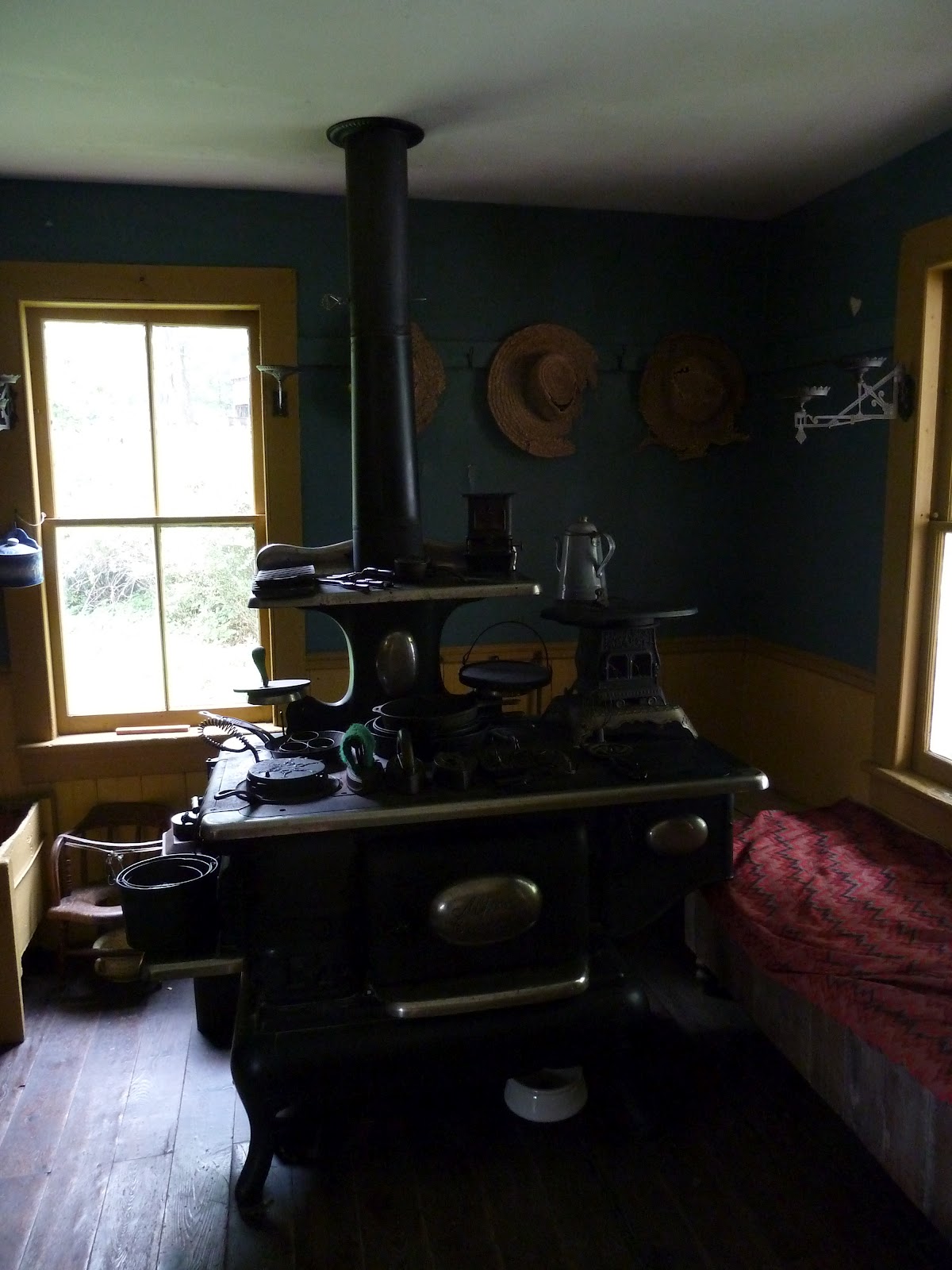
Tours are lead by "family members" who revel in telling guests about all of their "modern" conveniences. How much easier life is now (in the 1890s) than it was when "grandpa" began farming. It is cute and annoying at the same time. The discussion about the modern appliances in the kitchen came across as a Pampered Chef demonstration about how lucky the housewife is to have all of these gadgets that her husband, Harvey, kept buying for her. The stove in the picture was quite expensive -- $25 back in the late 19th century. Her husband brought it home for her in his wagon. 

The grandson was quite excited to have a modern-day "fiddle" to distribute seed rather than having to hand sow it like his grandfather. 

All of the presenters were enthusiastic. Each was excited to tell us about "their" lives.

On the day we went, there was a wool-dying presentation. Costumed re-enactors were using heavy pots to dye wool. Sometimes they added iron to change the color of the dye. The presenter became a bit too animated, though, when explaining the old-fashioned technique for making wool indigo-colored. Let's just say it includes everyone peeing in a pot and letting that sit for 6 weeks in the sun. Hard to look at the color again without thinking "ewww."


In addition to more staff than I normally see at small historical sites, there were also a bunch of animals. There were at least 6 goats, 5 pigs, 4 sheep, two horses, a mule, a bull and a foal. 

Our biggest challenge of the day way finding the place. It is tucked in the mountains only a few miles away from the Delaware Water Gap. A couple of signs would have helped. If three college-educated women with GPS units and website directions have troubles finding the place, it is not easy to find. Fortunately we also had children in the car saying (as we drive by) "is that it?" We were all glad that we were not the only ones dumb enough to drive past the unmarked parking lot. 

Thank you for the fun outing!


Updike Farmstead


In 2004 Princeton purchased Updike Farmstead, an historic farm located on Quaker Road. Thanks to a bunch of grants, the Princeton Historic Society renovated the late 18th century farm house in 2009/2010.


The renovations are stunning. In one hallway is a series of pictures documenting the transformation. 

http://www.princetonhistory.org/locations/updike-farmstead.cfm

What drew me to the farmstead was the exhibit on Ellen Axson Wilson's American Impressionist paintings. Mrs. Wilson was First Lady when Woodrow Wilson was President. Many of the paintings in the collection were created while Woodrow Wilson was Governor of New Jersey and they lived in Princeton.

http://www.woodrowwilsonhouse.org/index.asp?section=news&file=news&ID=144

Ashley's favorite part of the tour was the scavenger hunt. Many museums (at least the ones trying to encourage families) have scavenger hunts. Often they are "I Spy" games where the kids are asked to find something inside. This was the first time we played the game outside. On the list were easy items, such as an oak or maple leaf -- stationary items. Then there were things we should be able to find (an acorn, a pine cone). As a storm was about to hit, we struck out on the live creatures (ladybugs, worms, and birds). Ashley did manage to find a deer track, which was not easy in the rock solid ground, but we could not find a feather on the property. It was an interesting scavenger hunt since we had no control over finding it all. We gave up before the storm since Ashley is familiar with all of the objects.

The farmstead is only open on Wednesday and Saturday afternoons from 12-4. It costs $4 to visit. If you are not interested in American Impressionist art painted by a First Lady, I would recommend waiting until they have an exhibit that you would like better. It is "new." Hopefully it will grow and continue to get even better.

Sunday, July 1, 2012

Quebec: Site Traditionnel Huron

On most Sundays, Ashley is a junior tour guide at the Lenape Village at the Churchville Nature Center. Her knowledge of their pre-Colonial lives is vast. I specifically sought a Native American site for Ashley to visit. in order that we could compare the Lenape Culture with the Hurons.

My search yielded the Site Traditionnel Huron, located on the Huron-Wendat Reservation just outside of Quebec City.

The tour began with a native dance. It included several buildings including a long house, explanation of smoking food, a sweat lodge and a tepee with ritual masks inside of it. 

We had a private tour. The guide was able to help us work through how the Lenape and Huron cultures were the same and how they were different. They were both matriarchal, and they both had clans. The languages were different. Lenapes were more nomadic, hence the structures built by the Huron were more permanent. 

The tour was fine. It ended with an incredible gift shop filled with crafts made by First Nation people from all over Canada. It lacked the charm of Churchville Nature Center. I felt rushed through the tour, even though they said we could go back to any site afterwards, I still felt in the way.

Unless you have a strong love of Native American culture, I would not spend the 30 minutes driving to Wendat to visit this site. We had thought we would spend all day. However, the restaurant with lots of Native American food did not open until noon, and we were done with our tour by 11 AM. If you do decide to go, aim for later in the day in order to also feast on their delicacies. 

Local friends, if you have a free Sunday afternoon between April and October, check out one of Miss Patti's tours at Churchville Nature Center. With any luck (or coordinating in advance) Ashley will be there helping Patti. The tour is only $5 and lasts at least 90 minutes. It is very interactive.


Quebec: Place Royale

Our time in Quebec City was limited. I had hoped to visit the Museum of Civilization, but ran out of time. Also in the Old Port section of town is the charming Center of Interpretation of Place Royale, a low-budget museum about the 400-year history of Quebec City. Instead of a glossy brochure, the museum hands out a photo copy sheet with all the necessary information. Their website is not nearly a glitzy as others.

The museum has three main exhibits, plus a 3-D movie called "Facing Champlain" about Samuel de Champlain -- the man who discovered Quebec. The exhibits are hands-on. They are fun to play with, as well as educational. Fortunately (for us) everything is in English, as well as in French. 

The real treat with this museum is the enormous dress-up area in the basement. There are costumes along all four walls in sizes ranging from toddlers to grown men. They also had hats and bonnets (which we skipped due to fear of lice). Our only issue was that Ashley's size did not seem to exist. They had dresses for little girls, and for teenage girls, but some were way too short and others dragged on the ground. We spied a group of teenagers hanging out in there and having a blast. 

We each put on a costume. Then moved into the enormous play area. This section was designed like a house of a middle-class person -- or someone even more affluent. There was a master bedroom, eating area, play area. and large spaces in-between. For a while we had the space to ourselves (the teens had moved on to another part of the museum). We had fun taking pictures of each other. Fortunately an older couple came and took a couple of family pictures for us. The husband was deaf, and could only read lips in French. that added a small challenge for me. 

 After all that playing, it was time to hop in the car and head towards Montreal.


Quebec: Morrin Center

Wishing I could go to Quebec, somehow failed to translate into "what would I do if I went to Quebec?" A couple of weeks before we left I started searching websites, and asking friends for advice. After subtracting time for the drive, we were only going to be in Quebec City for two days.

I looked for something to interest each of us -- First Nation (Native American) site for Ashley, biking for Don, history for me. 

The Morrin Center quickly floated the top of the list of places I wanted to visit. We were lucky in two ways. One, the Morrin Center is located down the stairs from out hotel (yes, stairs to cross streets), and two the  Morrin Center started up tours on the our full-day in Quebec. A week earlier and we would not have been able to go on a tour.

Our tour guide, Ben, lead us through the Morrin Center's unique history. It started off as a military barracks (1712-1808) the the prison for the city of Quebec (1813-1868). They held the worst criminals of the day -- people who stole tea (which came from China), a horse thief, an indentured servant who ran away from his master, as well as the lesser criminals. They adhered to the most modern prison reforms of the day -- including separating inmates based on the severity of their crimes and prisoners bathed on a regular basis. Some of the criminals were hung out front off of a balcony that no longer exists. It was a pretty scary place to be sentenced.  Unfortunately as the city grew, they outgrew their space.


A few years later (1862-1902), it was converted into the city's first English-language college. In 1885 they started admitting women to the program. The rooms that exist are stunning. In the far back corner of the science lab is a dark room that was donated by Mr. Eastman (of Eastman Kodak). 
 Today it is the only English-speaking library in Quebec City. Rather than waiting at our hotel room for our tour in English, Don and Ashley sat in the children's section of the library and read books.

This is the first collection I have ever seen that uses the Cutter System. They are quite proud of the fact that their entire fiction collected is sorted by author, and not by genre. I'd be interested to see how this kind of system could work on a much larger scale. I'm always curious as to how places organize their collections. 

The tour was fascinating. I am glad it worked out so we could see the place, and have a tour in English. Don and Ashley were happy for a little bit of quiet time to sit and read. A win for everyone.


Quebec City

A weekend of bike tours in Montreal prompted us to go to Canada. After years of drooling over images of Quebec City, we decided to drive the extra three hours and also visit Quebec City.

Quebec was everything I heard it was -- more French than France (stop signs say ARRET instead of STOP), "Old World" charm in a relatively new city, and old walls to walk around. It was easy to pretend we were in Paris.

We stayed in the center of the Old City at the Jardin de St. Anne (Ashley cannot seem to avoid St. Anne wherever she goes we find Mary's mother haunting us). It was a quirky hotel with a spinning wheel decorating a hallway and lots of exposed stone walls. In addition to being downtown, one of its best features was that it had a dining room on the first floor where you could bring a meal and eat it at "home." 


It is a wonderful city for walking, and a miserable city for driving -- which suits us perfectly. Once we parked the car, we did not need it until we left town.

 It is also a very hilly city. Our first clue of how hilly it is should have been when we learned about the funicular and saw stairs and elevators linking streets together. Between the stairs and the cobblestones, it is not the most bike friendly city. I did see a lot of people out running, so it is a good place to go for hill training.

My favorite part of the city was just walking around and soaking up French. I chuckled when when I saw an "Ecoliers" bus. I rolled my eyes at phrases such as "fin de la semaine" instead of "le weekend," which the French use. I think I could have spent days just sitting on benches eavesdropping on conversations in French. In some ways, a foreign language is like riding a bicycle -- you might not use the skill for a few years, but it comes back to you.


Eating was another big treat. Lots of restaurants. We left our eating comfort zone and had crepes instead of sandwiches (so it wasn't a big stretch). 

Beautiful weather also helps, and we had picture perfect days.


Friday, June 29, 2012

Soldiers without Guns: Women Defense Workers in WWII

I love a good first person re-enactor. A good re-enactor can make you feel as if you have just traveled back in time. They make you feel as if you have met the person they are teaching you about. As a history buff, I have been enthralled by their stories. I often quiz them about their lives. I always learn something from them and feel an attachment in a way that simply reading about the "person" or watching a movie cannot do. I become engaged with their lives.

Over the years I have engaged with Stacy Roth in this manner. She has programs as part of her "History on the Hoof" business. A great way for a local organization to hire her is through a Horizon Speakers Program grant available from NJCH for such a purpose. We have seen Stacy as Molly Pitcher, and as a refined 18th centuryb lady educating us 20th century people about tea. Most recently, I saw her in overalls and a red bandanna as "Rosie the Riveter" in hyer "Soldiers without Guns: Women Defense Workers in WWII" program. 

Technically, this was my second time seeing her as Rosie. The first time was at Peachfield a month earlier. I got lost. I got very lost. By the time I found Peachfield, Stacy was almost finished. She told me should would be reprising her role at the First Presbyterian Church of Woodbury Heights -- not far from Don's office. We all went. Ashley was asked to demonstrate the outfit welders would have worn. It was a bit big on her.

Stacy brought that era to life. All able women took jobs in order to free up the men so they could go off to fight the enemy. In "her" case she learned how to be a welder. Other women drove buses, made deliveries and took other jobs traditionally held by men. After her presentation, members of the audience were encouraged to share stories about their lives (or the lives of their parents) during WWII.

Her presentation made me think about life in America now.  We've been fighting a war in Afghanistan and Iraq for over a decade. Few Americans are making enormous sacrifices. Many are making no real sacrifices. Back in the 1940s, scrap metal was collected to make weapons. People made do with what they had. They grew Victory Gardens. The war was huge news. Everyone did their part for the good of the country. Today most of us don't have that same connection. Personally I know one person who was killed in action (David Weigle) -- the son of our former pastor. I know of a few others who have or who are serving. Most days pass without my giving that part of the globe a moment's thought. I think that is true for most (not all, of course) of the people I know.

It is a different time. 

We still need to support our soldiers, our vets and their families. They have many needs. 

I do not wish enormous sacrifices on our part, nor did I start writing this planning to turn it into a political statement. 

Thank a soldier, a vet, or their family today and every day.

Tuesday, May 8, 2012

The Lady, The Chauffeur and the Locomobile


We are very blessed to be living in an area that is so full of history -- and a very wide array of history that spans over 300 years. This post features a modern woman from 1910 who is a role model even a century later. I learned about her cross country travels from Becky, the grand-niece of "the chauffeur," Harold Brooks.

Harriet White married Clark Fischer, owner of the Eagle Anvil Company in Trenton, NJ. Three years later, he died in a train crash, she survived the crash. She took over his business -- quite a daring thing for a woman to do at the onset of the 20th century at a time when women were not even allowed to vote. The men scoffed at her, but she soon turned the business into a huge success.

Fast forward a few years to 1909. She decides to embark on a journey that would take her around the world. Picture life in 1909. The Orville brothers had successfully flown an airplane only 7 years earlier. Many places did not have roads. The "war to end all wars" had not happened. The Titanic was just beginning to be built. Cars could drive at 10-15 MPH. To say life was a bit different, would be an understatement.

A quick question to see who is paying attention: Why didn't she just take a train? Answer: her husband had died in a train crash and she was afraid of traveling by train.

Harriet White Fischer did know how to drive, but she brought along her chauffeur (Harold Brooks), a chef (she still wanted to dine in style) and a lady servant. Brooks was in charge of the logistics for the trip and for maintaining the car. Fortunately while he did have to change the tires about 20 times, nothing else went wrong with the car.

He also took over 200 glass slides during the trip. Over the past century, these slides were transferred to more modern slides. In the 1970s (?) his family recorded him describing the slides as he told his side of the story. That is what I had the pleasure of seeing and hearing at the Benjamin Temple House in Ewing, NJ. 

Brooks took a picture or two at every crucial point during the trip -- the loading of the car into a boat, an airplane they saw in France, pictures at different stops, and at different sticky situations. I could learn a lot from him -- sometimes less is better. In today's digital age, I would take 200 pictures just of the car in a crate to get the right image. His relatively few slides told the highlights of an adventure that lasted over a year.

Another lesson ... record people's stories in order that the next generation may enjoy them. Mrs. Fischer was well-known locally, but not a household name today. Her adventures live on.

A lesson from Mrs. Fischer -- follow your dreams and go on adventures. You never regret the things you did do, only the missed opportunities.

Go out there and have some adventures, then write about them so they are never forgotten.

For more information: http://www.capitalcentury.com/1910.html

Wednesday, March 14, 2012

Dining with John and Abigail Adams

For the fourth year in a row, we had dinner with a colonist at the Cock and Bull Restaurant. Last year we dined with Betsy Ross and Oney Judge (Martha Washington's personal slave who escaped from Philadelphia to her freedom). This year we ate with John and Abigail Adams. 

The evening was part of their Colonial Kitchen series, which has taken place winter Monday nights for over 25 years. The food is plentiful-- soup, salad, two entrees and dessert. The price has remained $21.95 for adults and $10.95 for children for as long as we can remember.


A side note: Ashley is wearing one of my dresses from when I was about her age. Even though I was taller than her at this age, hemlines were a lot shorter in the mid-1970s.


The best part of the event was watching John and Abigail make goo goo eyes at each other. More than 200 years later and they are still very much in love -- or so it seems.


As always, Marianne and Tom Tucker of Tucker's Tales provided the entertainment. They regaled us with their amazing collection of Colonial tunes. They are always happy to see us, either here or at one of their other events. They love history and they love performing together. 


Looking at this year's list, there are still lots of great "people" to meet.

Meeting Albert Einstein


Two years ago, Princeton Tour Company decided to create an event called Pi Day in honor of Albert Einstein's birthday (March 14 -- get it 3.14). Einstein worked for the Institute for Advanced Study and lived at 112 Mercer Street in Princeton. Locally we was known for being kind to children, loving ice cream, and riding his bicycle. Last fall we met a man who, when he was a small child, remembers meeting Einstein. He confirmed he loved children.

Last weekend Princeton celebrated Pi Day. Activities took place all over town, including the Princeton Public Library, the Princeton University Art Museum and the Historical Society of Princeton

We only attended one event, but it was a lot of fun! We rode the Dinky with Albert Einstein, his mother, his first girlfriend, his first wife, his secretary and other good friends. The "Dinky" is a two car train that shoots off of New Jersey's Northeast Corridor train route directly to Princeton University's campus. It is a 5-minute train ride to the Princeton Junction train station. It currently costs $2.75 each way. There are talks about relocating the Dinky, which will probably mean the end of this historic train.


Sunday's train ride was historic for another reason. Albert Einstein was alive again and riding the train on his way to New York City. It was just like a character meal at Disney, or eating with a Colonist at the Cock and Bull Restaurant in Peddler's Village, PA. It was also a bit odd because the characters were never with each other in real life. His mother, his first girlfriend and his first wife never left Germany. His secretary and local friends never went to Germany. His mother berated her brilliant son as if he was the village idiot ("Albert do you remember where you are going?" "If you are good, we'll get ice cream afterwards."). For all we know, that is how she really treated her son. She told us his door at 112 Mercer Street was painted red so he could find it. It is now black.

You could tell the interpreters were having a fun time with the experience. They rode the train back and forth 3 times before heading into Princeton for more activities. I hope this is one event they can and do repeat next year.

To learn more about Einstein visit the world's only Einstein Museum at 102 Nassau Street in Princeton. It is located in the back of a store and is free or read these stories about Einstein's life in Princeton during the 1930's. The website includes gems of stories such as: 
Einstein's first act in Princeton was to buy an ice-cream cone. He stopped at the Baltimore ice cream parlor on Nassau Street and ordered vanilla with chocolate sprinkles. An amazed divinity student, John Lampe, watched a transaction that stayed with him the  rest of his life. "The great man looked at the cone, smiled at me ... and pointed his thumb first at the cone and then at himself," Lampe later recalled.
When we rode the train with Einstein, he kept talking about getting a vanilla ice cream cone with chocolate "shprinkles." His love of ice cream was so famous that when the movie IQ was filmed in Princeton in 1994, Walter Matthau was photographed eating ice cream at Thomas Sweet while still in his Albert Einstein costume. It was a classic picture!

And so continues our tradition of spending time with people in history.

Tuesday, January 17, 2012

Thomas Edison's Lab


Thomas Alva Edison: The Wizard of Menlo Park, also known as (at least according to The Flintstones) Thomas Edistone -- the inventor of the candle. Holder of 1093 patents in his life time built the largest research and development facility of its day in West Orange, NJ. In the height of operations he had over 10,000 people working for him.

Back in the mid- to late- 1990s there was a rumor Edison's labs might close forever. Yes, even in the booming days of the 1990s historic sites were threatening to close due to budget issues.

Instead of closing their doors forever, though, they closed for seven years (2002-2009) during which time there was a major renovation. If you have not been to Edison's labs in over a decade, it is worth returning to see the massive improvements.


Back when we went circa 1995, this is the only room I remember seeing -- the library. Edison's bed in the corner really stood out to me. He often worked 95 hour weeks (he has the time card punches to prove it) and would take cat naps in his library. I also remember seeing the Black Maria, where he made his first films.

Today there are over 400,000 pieces on display, including this -- the first phonograph. There are also rooms with heavy machinery in it where prototypes for his experiments were made. Much of the renovations were based on photographs, which are also on display. They are fortunate to have so much documentation. 
Another highlight of the laboratory complex were the free tours offered every half hour. We went to two of the tours. Our first tour was in the chemistry lab, which was left pretty much as it was in Edison's day. We then went to the Music Room where we heard old phonographs play tunes. Even seeing them in action, and having the docent explain how the phonographs work, I still don't understand it. If I did, I would gladly explain the magic to you.


After touring the laboratory complex we went to his home, Glenmont in the Llewellyn Park district of West Orange, NJ.  Llewellyn Park is just up the hill from his labs in a very exclusive neighborhood. Neighbors included the Merck and Palmolive Families. Edison's home, which he shared with his wife, Mina, and their three children had 29 rooms. The room that juts out on the second floor is their family room where Edison would retreat from public life to think.  The home was originally built with gas lighting in 1880, but was quickly converted to electricity after the Edisons moved into Glenmont.


The combination of seeing where someone famous both lived and worked is rare. I'm glad were able to visit on a cold Sunday afternoon. It was even nicer that we were able to participate in one of the National Park Association's fee free days.

Each year the President declares set days to be free at all National Parks. We were pleased to learn the audio tours were free, too.

National Park Service Week
April 21, 22; 25 - 29

Get Outside Day
June 9

National Public Lands DaySeptember 29

In observance of Veterans DayNovember 10, 11


Thomas Edison's Labs: http://www.nps.gov/edis/index.htm