It all started on September 11, 2001, or rather on September 12th. Because I didn't want the news to connected to that horrific day. Yet, somehow 18+ years later it feels like it is.
I took a pregnancy test.
It was positive.
On May 17, 2002 we welcomed Ashley into the world.
The beginning of a story. The beginning of dreams for our little person.
This week I (and everyone else reading this) am dealing with the loss of dreams. I dreamed about her last high school production. I dreamed about her walking down the Senior Fashion Show aisle. I dreamed about her receiving college acceptances (which should still come) and touring the schools (which won't likely happen).
Today the governor put in restrictions I never thought possible. We have a mandatory curfew from 8 pm to 5 am. Shops and restaurants are forced to close. Schools are closed until he deems it okay to open them. Already international airline travel has been curtailed. Events under 250 (now 50, maybe even less) have been cancelled, including my gala. Grocery store shelves (toilet paper and meat most noticeably) are empty.
As I mentally adjust to the new restrictions, more rules are being enacted.
Our beloved library is closing tonight at 7. On Saturday it was business as usual. On Sunday they started wearing gloves. On Monday they announced closing their doors for the foreseeable future.
The foreseeable future.
Social distancing.
Remote learning.
Flattening the curve.
When will it end?
I wonder if it really matters. What if we just let it naturally spike the numbers and all take our chances? Those worry stay home. The rest of us live our lives and make our memories.
If this was only a two week pause, I could handle it.
If I saw some sign of hope, like snow melting after a blizzard, I could handle it.
Instead we are all left with uncertainty at a time we should be celebrating. We are left wondering if the Disney trip, proms, graduation, and senior celebrations are next. On a greater scale, left wondering what businesses will fold. Left wondering how long before we recover as a world.
It is not fair.
Yet, as I read social media, I am not allowed to feel it is unfair. It is for the greater good, not just for me and our daughter.
We will never reclaim this time. We will never reclaim these milestones. It is a loss. I am allowed to grieve. I am allowed to wish we would redo this in May and June instead of in March and April. I am willing to send her to school through mid-August if it meant she could give her senior speech at the cast party that was cancelled last weekend. If it meant taking pictures at her prom. If it meant cheering for her and her friends at graduation. If it meant the Disney trip would still happen. If it meant we still had that last parent-teacher conference where I could thank your teachers for everything.
Instead uncertainty.
Instead fear.
Instead extra stress.
Instead hopelessness.
Any other two months and I would embrace the chance to slow down and embrace life with my family. Why now?
Instead I am mourning.
Instead I want to cry, but the tears are not coming.
Instead I want to hug someone until the tears flow, but social distancing prevents contact.
I am reminded of that pregnancy test and being happy for our future when the world was mourning and I was not able to fully be happy because others lost so much. Now I'm going through those same feelings again -- not allowed to be upset because it is for the "greater good."
So far I am taking this harder than Ashley, and definitely harder than Don. I recognize that, but I am still hurt. It will take me a while to recover.
I'd love some optimism that schools will reopen. That the Disney-theme parks will reopen. That the numbers decline. I'm just not feeling it right now.
Monday, March 16, 2020

Sunday, March 1, 2020
Year Five for the Tomato Soup and Grilled Cheese 4-Miler
Being a legacy runner for a race means you feel compelled to do it even when you shouldn't. That was the case today.
Having run the Bucks County Runners Tomato Soup and Grilled Cheese 4-Miler for the past four years, I was determined to make this year five. It didn't matter that the scratchy throat I've been dealing with since Tuesday made me wake up without a voice. It didn't matter that I ran on Friday and Saturday at less than full steam because of a challenge I made to myself to run at least ten 5ks (or greater distance) every month. It didn't matter that it was 31 degrees but felt much closer to 20. At least the sun was shining and I was determined to do it.
 The course is the same. We start with the spiral of death to help us spread out. At the 1.1 mile mark we hop on the towpath at Washington Crossing State Park in Pennsylvania and run a little over 2.6 miles before we turn around. The fast people passed me at 1.6 miles this year. Don reached the turn around about .05 miles before me. I really slowed down on the last 1.4 miles.

On the plus for this year, it was not muddy.
The line for the tomato soup at the end was long, but the soup was plentiful and delicious. As were the grilled cheese sandwiches, or so I heard.

I enjoyed catching up with Gabrielle.
It was still cold at the finish line, so we headed home to warm up.
Of note this year, the early registrants each got a toasty warm hat. I put mine on after the race so I didn't have any bad race mojo. I needed all the help I could get.
According to my watch, I finished just under a 12-minute mile pace. Certainly not a PR, but respectable given how I was feeling. Fortunately the rest of the day called for spending time under the blanket with the fireplace on blogging about adventures.
Having run the Bucks County Runners Tomato Soup and Grilled Cheese 4-Miler for the past four years, I was determined to make this year five. It didn't matter that the scratchy throat I've been dealing with since Tuesday made me wake up without a voice. It didn't matter that I ran on Friday and Saturday at less than full steam because of a challenge I made to myself to run at least ten 5ks (or greater distance) every month. It didn't matter that it was 31 degrees but felt much closer to 20. At least the sun was shining and I was determined to do it.
 The course is the same. We start with the spiral of death to help us spread out. At the 1.1 mile mark we hop on the towpath at Washington Crossing State Park in Pennsylvania and run a little over 2.6 miles before we turn around. The fast people passed me at 1.6 miles this year. Don reached the turn around about .05 miles before me. I really slowed down on the last 1.4 miles.
On the plus for this year, it was not muddy.
The line for the tomato soup at the end was long, but the soup was plentiful and delicious. As were the grilled cheese sandwiches, or so I heard.

I enjoyed catching up with Gabrielle.
It was still cold at the finish line, so we headed home to warm up.
Of note this year, the early registrants each got a toasty warm hat. I put mine on after the race so I didn't have any bad race mojo. I needed all the help I could get.
According to my watch, I finished just under a 12-minute mile pace. Certainly not a PR, but respectable given how I was feeling. Fortunately the rest of the day called for spending time under the blanket with the fireplace on blogging about adventures.
Katie's Run

Katie was hooked.
Katie decided when she turned 40 she would do the same. Between her running group and other parts of her life, she has a lot of running friends. At one point she had enough friends each person would have to run 2.67 miles.
That's when Don and I chimed in we would do it, too.
As the day drew nearer, and the forecast turned colder, we were afraid some people would bail. Though we didn't want to run a half-marathon that day, we were prepared to do so for Katie if we were the only ones who showed up.
 The plan was to meet at the Grandparents Park near the Marina at Mercer County Park at 9 am on February 29. Though we have had some warm days, this was not one of them. Fortunately it was not raining or sleeting. Just cold. About 30 degrees, but feels like the low 20s cold.
We showed up in time for the count off. There were 28 people, mostly women.
1.42 miles each.
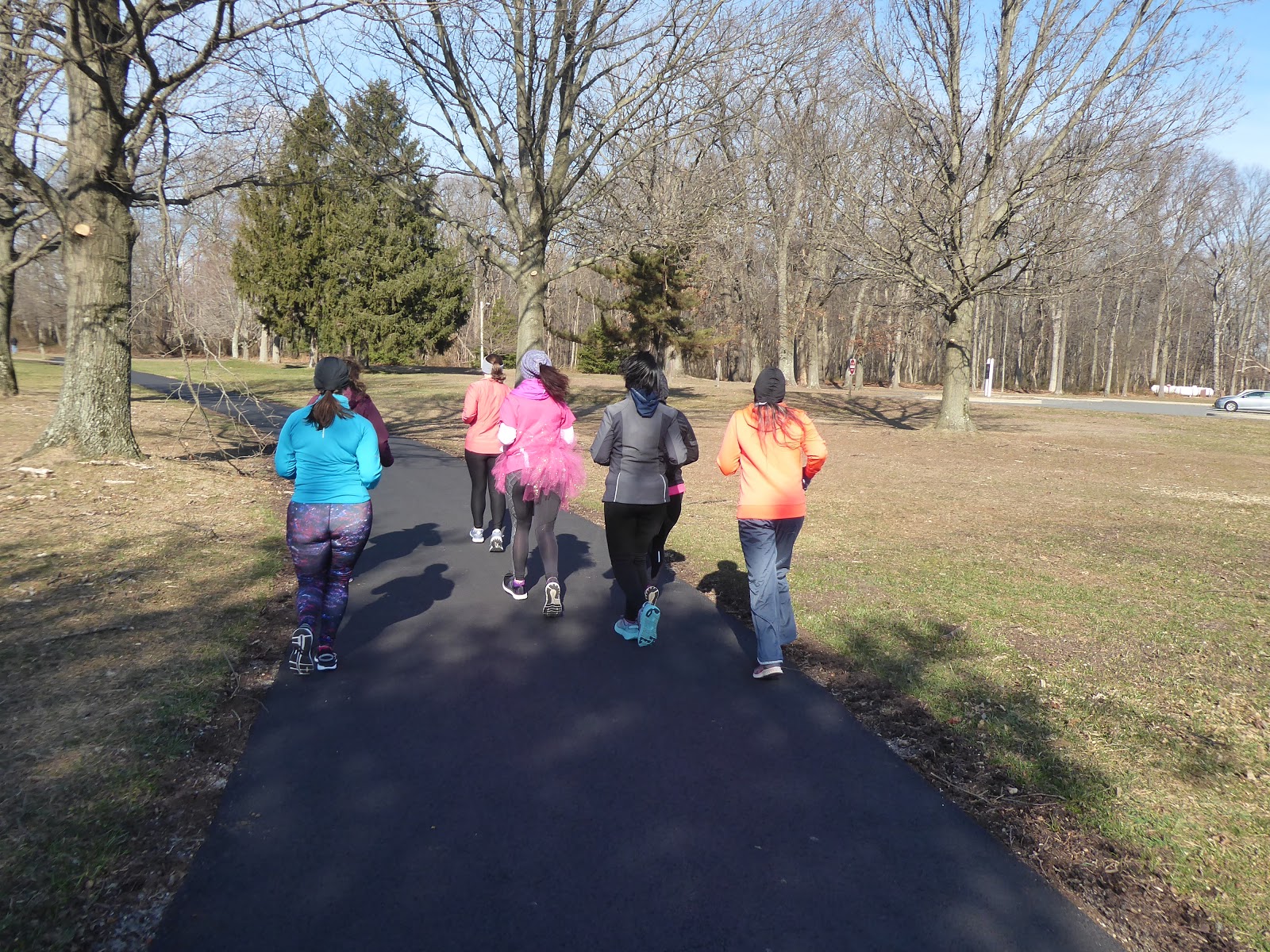
We headed out like a flock of flamingos (the goal was to dress in pink) and turned left past the memorial. Ran for .7 miles and turned around. That easy.
Having a cold, and having run a 5k the day before with a 4 mile race planned for the next day, I was much slower than usual. Either that, or I was aiming to keep Katie's pace. Yeah, that's my story and I am sticking with it.
As I passed a couple walking, I encouraged them to shout Happy Birthday to Katie. They did.


We did have fun. The sunshine helped. It always does.
Afterwards there were flamingo cupcakes and other celebratory activities. Don and I went home. Some skipped the running and arrived in time for the party. Others skipped the party and only went to the run. I suspect in the end it worked out as it was supposed to -- just right.
Cornelius Low House

 The back story is not long after cleaning out Honey Bunny and Pop-Pop's house I saw a call on H-Net (a list serv dedicated to all things historic in New Jersey) for items relating to mid-century life. The Cornelius Low House was planning an 18-month exhibit and wanted items to display. My heart fell into my stomach. I had a house-full of items they could have had.
Still I made a note I wanted to see the exhibit after it opened.
 Time flies. Unless something is put on the calendar, it often does not happen. Something like this that does not have a real date is very easy to not have happen.
The museum is free. The exhibit was well-done with lots of eye catching displays explaining the post-WWII era and how life changed for average people.
It felt like a time capsule. I saw dishes I used growing up, and even a Pillsbury cookbook (good chance I recycled a similar one a couple of years ago).
 When I could distance myself emotionally from cleaning out their house, I enjoyed the exhibit. When I couldn't I felt I needed out of there immediately. That's no fault to the museum, only how emotions can pop up when you don't expect them to.
 The first floor had a complete, and rather pristine, living room set. The description said it was from the donor's parents' house and left untouched since (if my memory is right) the 1970s. At least Don's parents upgraded their living room set in 50 years and used the place. The living room was a new concept in the 1950s.
 The upstairs was much sparser. There was a room talking about the popularity of drive-ins. More fully decorated 1950s rooms would have added to the exhibit. I talked to the person at the museum. She said they had lots of donations to choose from. Next up, though, they are returning to the Colonial Era of Cornelius Low.
 The exhibit runs through June 28, 2020. There is a little bit of parking (about 4 spaces), likely enough for their needs.
 |
| Our washing machine is old, but not THIS old. Fortunately Honey Bunny's was not this old, either. |
 |
| We had these dishes growing up, as did Don's family. |
"Behind Enemy Lines" by Marthe Cohn
Three years ago I heard Marthe Cohn, author of Behind Enemy Lines, was going to give a talk in New Jersey. The rest of the title is: the true story of a French Jewish Spy in Nazi Germany.
A quick google search I was hooked on what I read about her. I borrowed her book from the library and was mesmerized.
Unfortunately the day of her talk it was snowing and the drive was at least an hour away. I made the decision to not hear her speak, knowing it was likely the last opportunity I would have. She was 96-years old and living in California. It was only by chance I heard about her presentation.
 Fast forward to 2020 and I heard through the magic of Facebook that she was returning to New Jersey to give a talk at Princeton University. No snow in the forecast. No other plans that day. The only decision I had left was do I buy her autographed book, or simply attend her lecture.
I splurged. I do not buy a lot of books, instead I support our local library, or friends why write books.
 The timing of her talk coincided with the 75th anniversary of Auschwitz being liberated. The student who introduced her said his grandparent (or maybe it was great-grandparent survived the Holocaust). I later overheard events such as this one are only open to Princeton University students, faculty, and staff. I was fortunate that it was opened to the public, and that I heard about it.

Marthe Cohn is a 99-year old French woman who grew up in an Orthodox Jewish family just over the border with Germany. She was able to slip behind enemy lines as a spy as an ordinary woman in extraordinary experience. She became the hero that was needed.
In 2004 someone interviewed her for five hours and created a video about her life. After watching the 10-minute video she spent the next 20-minutes (or so) clearing up the misconceptions in the video. I wondered why she didn't have a new video made, but maybe she realizes the impact of explaining her story through the mistakes.
The first mistake is she grew up near Metz, not Alsace-Loraine. The difference being in Metz they learned true Germany. In Alsace-Loraine the locals speak a dialect.
The other is that her sister Stephanie was taken by SOPI, not the Gestapo. SOPI was formed in March 1942. Stephanie was arrested on June 17, 1942. There was a farmer with a farm on both sides of the border who helped people cross from Occupied France into Unoccupied France. He saved allied pilots who were shot down, and saved many Jews. Stephanie made a fatal mistake when she returned some cigarettes someone left behind and signed her name to the letter. Her real name.
Back to her history. She was born in Metz, France in 1920 and kept her past a secret for 50 years. She was one of seven children. The Prussian Army of Kaiser Wilhelm I occupied Paris from 1870-November 11, 1918. During that time it was illegal to speak French. Though she was born two years after the occupation, she spoke German at home and learn it from her parents.
In September 1939 the family moved to Poitiers, a safer part of France. It was not safe for long. In the meantime, they went about their daily business, she became engaged, they hid Jews without papers, her fiance was with the Resistance and was arrested. Her sister was arrested. Then her father was arrested as a way to make her sister talk. Her father was released. Though they had plans to help her sister escape, they were never carried out. The sister knew she was being useful in prison as she took care of the medical needs of the children. More importantly she knew if she escaped, they would come after her family and friends. Her family was allowed to visit her (something that seems so unbelievable, though I have read about this in other books about the same time period). On September 21, 1942 (Yom Kippur) she was deported to an unknown destination, later they learned it was Auschwitz, and they lost contact with her.
An interesting fact I learned recently was that 75% of the Jews in France survived because French citizens risked their lives to take care of them. More than in almost any other European country at the time. Only Denmark had a higher percentage. Many families hid at least one Jew.
Marthe was a nursing student in Marsielles. She traveled with false papers. Her fiance was arrested with his brother and friends. They were tried and executed. She moved to Paris and lived with one of her sisters. With her false papers she could go into public spaces, including the train station and food store. Jews with the Jewish stamp could only shop in the last hour. In those days there were no super markets, you had to go from store to store to store to buy everything, and presumably stand in lines at each one, a task that would take more than an hour. Some shop keepers would bundle up the groceries in advance to speed them along. They did this at great personal risk.
Marthe went to nursing school. At her school her friends hid her whenever the Gestapo came, risking their lives. She started her studies in Montpelier, but the director wouldn't let her work. She went to Marseilles where she heard that director was very sympathetic. After a bit of back and forth between the director and someone else, she was accepted. She graduated in 1943 and returned to Paris to live with her older sister. She used her forged ID card to get a job with an agency.
By this point France was liberated, but the war was still happening. She tried to get a job with the government, but was told since the city where she was born was not liberated, she could not work for them. She tried to use her forged papers to get a job, but the hiring person recognized them as a forgery and turned her down.
Marthe reconnected with the mother of her fiance. When she realized she was all alone, Marthe and her sister invited her to live with them in Paris. They took care of her. They visited the cemetery at Ivry to see where her sons were buried.
Her fiance's mother met and befriended General Charles DeGaulle who asked what he could do for her. She asked for a role for her not-quite daughter-in-law. Marthe ended up in the 151st Regiment in Alsace. During a debriefing she was asked what she did during the war. She explained she tried to join the Resistance, but at 4'11, very thin with blond hair and blue eyes, she was rejected. No one trusted she was strong enough for the army.
She was told they didn't need any nurses, they need social workers. Not knowing what a social worker did, she accepted the challenge. The first uniform they gave her was much too big. No one gave her any directions, she she went to the front and asked the soldiers what they needed. They asked for blankets, food, and reading materials. She went back into town to get these items and returned with them.
Once an officer, Pierre Fabien, the first person to kill a German in 1943, realized she spoke both French and Germany, they hired this tiny, blond lady to interrogate prisoners. She underwent intensive training and was assigned to Africa.
Marthe became a spy. After 13 tries, she was able to get into Germany. She passed intelligence information to the Allies under the cover of being a German nurse looking for information about her Nazi officer. As she walked with people, including a German officer, she learned valuable information.
In February 1945 everything was frozen when Marthe landed in a canal. Turns out even military guides make mistakes, one gave her the wrong information. This guide failed to say there was a canal in her path. She was drenched from head to toe. It took a while to get out of the canal. She walked all night. Turned out she walked in a circle all night. She later learned if you walk without a compass at night, you will walk in a circle.
Marthe decided to go into Germany through neutral Switzerland. She was taken to the Swiss border. She went through the forest then through a field (many of her stories involve forests and fields) to where two heavily-armed German sentries were keeping guard 24-hours a day. She was with a middle aged man who made a strong pass at her, which she rejected. She was dressed as a German nurse without any French identification, all the labels torn out of her clothes, vouchers for everything she would need -- but no lesson on how or where to use the vouchers.
Marthe said the transportation was only at night, no military transport during the day, so Germans walked everywhere in groups. She found a group to join. The one high ranking German said to her (a Jew), "I can smell a Jew a mile away." As they walked, he told her about atrocities on the eastern front, which she had to smile through or else risk blowing her cover. She took care of him after he fainted, for which he was grateful and gave her his phone number. This came in handy later.
Three weeks later Marthe went to the Zigfried line and learned it was evacuated. She knew this was important information, but that it needed to be confirmed by three people before she could take it to her supervisor. She got the confirmations needed. The next challenge was to prove she was a friend since she had no documentation on her. She raised her right arm and made a V for victory as Winston Churchill had done recently. She recognizes she was extremely lucky they did not kill her on sight. They were skeptical, but eventually treated her as a VIP. When asked what they could do for her, she asked for a bicycle because she was tired of walking! She carried a letter in French past the Germans in the Black Forest. There was no time to get it coded. She put the letter in her left pocket with her hand on top of it to protect it. Following Col. Reinhard's advice, she got herself into Switzerland, told them she was a Swiss agent, and asked for help. She was safe.
In 1956 she came to the United States. She met her husband, Major, in Switzerland in 1953. The couple lives in California.
After the talk, Marthe answered questions while Major proudly showed off his wife's medals.
Time passed. She didn't talk about it. She figured no one would really believe her. In the mid-1990s she was back in France and asked for a copy of her military records from the French government.
Marthe Cohn was accompanied by her husband. Word has it he is a few years younger than her -- which still makes him in his upper-90s. He kept her on task during the talk. When she forgot a word or the story meandered, he brought her back. She speaks three language well.


A quick google search I was hooked on what I read about her. I borrowed her book from the library and was mesmerized.
Unfortunately the day of her talk it was snowing and the drive was at least an hour away. I made the decision to not hear her speak, knowing it was likely the last opportunity I would have. She was 96-years old and living in California. It was only by chance I heard about her presentation.
 Fast forward to 2020 and I heard through the magic of Facebook that she was returning to New Jersey to give a talk at Princeton University. No snow in the forecast. No other plans that day. The only decision I had left was do I buy her autographed book, or simply attend her lecture.
 I splurged. I do not buy a lot of books, instead I support our local library, or friends why write books.
 The timing of her talk coincided with the 75th anniversary of Auschwitz being liberated. The student who introduced her said his grandparent (or maybe it was great-grandparent survived the Holocaust). I later overheard events such as this one are only open to Princeton University students, faculty, and staff. I was fortunate that it was opened to the public, and that I heard about it.
 |
| The room was everything you dream an ivy school lecture hall being -- wooden desks with built in arm rest. The room across the hall had floor to ceiling blackboards. |
Marthe Cohn is a 99-year old French woman who grew up in an Orthodox Jewish family just over the border with Germany. She was able to slip behind enemy lines as a spy as an ordinary woman in extraordinary experience. She became the hero that was needed.
In 2004 someone interviewed her for five hours and created a video about her life. After watching the 10-minute video she spent the next 20-minutes (or so) clearing up the misconceptions in the video. I wondered why she didn't have a new video made, but maybe she realizes the impact of explaining her story through the mistakes.
The first mistake is she grew up near Metz, not Alsace-Loraine. The difference being in Metz they learned true Germany. In Alsace-Loraine the locals speak a dialect.
The other is that her sister Stephanie was taken by SOPI, not the Gestapo. SOPI was formed in March 1942. Stephanie was arrested on June 17, 1942. There was a farmer with a farm on both sides of the border who helped people cross from Occupied France into Unoccupied France. He saved allied pilots who were shot down, and saved many Jews. Stephanie made a fatal mistake when she returned some cigarettes someone left behind and signed her name to the letter. Her real name.
Back to her history. She was born in Metz, France in 1920 and kept her past a secret for 50 years. She was one of seven children. The Prussian Army of Kaiser Wilhelm I occupied Paris from 1870-November 11, 1918. During that time it was illegal to speak French. Though she was born two years after the occupation, she spoke German at home and learn it from her parents.
In September 1939 the family moved to Poitiers, a safer part of France. It was not safe for long. In the meantime, they went about their daily business, she became engaged, they hid Jews without papers, her fiance was with the Resistance and was arrested. Her sister was arrested. Then her father was arrested as a way to make her sister talk. Her father was released. Though they had plans to help her sister escape, they were never carried out. The sister knew she was being useful in prison as she took care of the medical needs of the children. More importantly she knew if she escaped, they would come after her family and friends. Her family was allowed to visit her (something that seems so unbelievable, though I have read about this in other books about the same time period). On September 21, 1942 (Yom Kippur) she was deported to an unknown destination, later they learned it was Auschwitz, and they lost contact with her.
An interesting fact I learned recently was that 75% of the Jews in France survived because French citizens risked their lives to take care of them. More than in almost any other European country at the time. Only Denmark had a higher percentage. Many families hid at least one Jew.
Marthe was a nursing student in Marsielles. She traveled with false papers. Her fiance was arrested with his brother and friends. They were tried and executed. She moved to Paris and lived with one of her sisters. With her false papers she could go into public spaces, including the train station and food store. Jews with the Jewish stamp could only shop in the last hour. In those days there were no super markets, you had to go from store to store to store to buy everything, and presumably stand in lines at each one, a task that would take more than an hour. Some shop keepers would bundle up the groceries in advance to speed them along. They did this at great personal risk.
Marthe went to nursing school. At her school her friends hid her whenever the Gestapo came, risking their lives. She started her studies in Montpelier, but the director wouldn't let her work. She went to Marseilles where she heard that director was very sympathetic. After a bit of back and forth between the director and someone else, she was accepted. She graduated in 1943 and returned to Paris to live with her older sister. She used her forged ID card to get a job with an agency.
By this point France was liberated, but the war was still happening. She tried to get a job with the government, but was told since the city where she was born was not liberated, she could not work for them. She tried to use her forged papers to get a job, but the hiring person recognized them as a forgery and turned her down.
Marthe reconnected with the mother of her fiance. When she realized she was all alone, Marthe and her sister invited her to live with them in Paris. They took care of her. They visited the cemetery at Ivry to see where her sons were buried.
Her fiance's mother met and befriended General Charles DeGaulle who asked what he could do for her. She asked for a role for her not-quite daughter-in-law. Marthe ended up in the 151st Regiment in Alsace. During a debriefing she was asked what she did during the war. She explained she tried to join the Resistance, but at 4'11, very thin with blond hair and blue eyes, she was rejected. No one trusted she was strong enough for the army.
She was told they didn't need any nurses, they need social workers. Not knowing what a social worker did, she accepted the challenge. The first uniform they gave her was much too big. No one gave her any directions, she she went to the front and asked the soldiers what they needed. They asked for blankets, food, and reading materials. She went back into town to get these items and returned with them.
Once an officer, Pierre Fabien, the first person to kill a German in 1943, realized she spoke both French and Germany, they hired this tiny, blond lady to interrogate prisoners. She underwent intensive training and was assigned to Africa.
Marthe became a spy. After 13 tries, she was able to get into Germany. She passed intelligence information to the Allies under the cover of being a German nurse looking for information about her Nazi officer. As she walked with people, including a German officer, she learned valuable information.
In February 1945 everything was frozen when Marthe landed in a canal. Turns out even military guides make mistakes, one gave her the wrong information. This guide failed to say there was a canal in her path. She was drenched from head to toe. It took a while to get out of the canal. She walked all night. Turned out she walked in a circle all night. She later learned if you walk without a compass at night, you will walk in a circle.
Marthe decided to go into Germany through neutral Switzerland. She was taken to the Swiss border. She went through the forest then through a field (many of her stories involve forests and fields) to where two heavily-armed German sentries were keeping guard 24-hours a day. She was with a middle aged man who made a strong pass at her, which she rejected. She was dressed as a German nurse without any French identification, all the labels torn out of her clothes, vouchers for everything she would need -- but no lesson on how or where to use the vouchers.
Marthe said the transportation was only at night, no military transport during the day, so Germans walked everywhere in groups. She found a group to join. The one high ranking German said to her (a Jew), "I can smell a Jew a mile away." As they walked, he told her about atrocities on the eastern front, which she had to smile through or else risk blowing her cover. She took care of him after he fainted, for which he was grateful and gave her his phone number. This came in handy later.
Three weeks later Marthe went to the Zigfried line and learned it was evacuated. She knew this was important information, but that it needed to be confirmed by three people before she could take it to her supervisor. She got the confirmations needed. The next challenge was to prove she was a friend since she had no documentation on her. She raised her right arm and made a V for victory as Winston Churchill had done recently. She recognizes she was extremely lucky they did not kill her on sight. They were skeptical, but eventually treated her as a VIP. When asked what they could do for her, she asked for a bicycle because she was tired of walking! She carried a letter in French past the Germans in the Black Forest. There was no time to get it coded. She put the letter in her left pocket with her hand on top of it to protect it. Following Col. Reinhard's advice, she got herself into Switzerland, told them she was a Swiss agent, and asked for help. She was safe.
In 1956 she came to the United States. She met her husband, Major, in Switzerland in 1953. The couple lives in California.
After the talk, Marthe answered questions while Major proudly showed off his wife's medals.
Time passed. She didn't talk about it. She figured no one would really believe her. In the mid-1990s she was back in France and asked for a copy of her military records from the French government.
Marthe Cohn was accompanied by her husband. Word has it he is a few years younger than her -- which still makes him in his upper-90s. He kept her on task during the talk. When she forgot a word or the story meandered, he brought her back. She speaks three language well.


Saturday, February 29, 2020
New Jersey Vietnam Veterans Memorial
Last fall Don and I were enjoying the exhibits at The Spirit of the Jerseys State History Fair in Monmouth Park, New Jersey (link from when we went in 2015) when we met a man from the New Jersey Vietnam Veterans Memorial in Holmdel, New Jersey -- a site I did not know existed.
As with much of life, I mentally tabled visiting the place for another time. Fortunately I remembered and put the visit on our calendar while Ashley was at rehearsal.
Begun in 1993, the museum and memorial were dedicated in 1998 by New Jersey Governor Christina Todd Whitman, whose husband, John Whitman, was a Vietnam War Veteran. A lot of planning went into every detail both the museum and the memorial. To date, it is the only place like it in the country.
 What truly sets this place apart from other museums and memorials is that all of the docents are Vietnam War Veterans. Each has their own story, and wants to share it. If they didn't, they would not be there. Many (if not all) suffer from health issues as a result of the time they served our country. We were told Gary, the gentleman who told us about the museum and memorial in September, was undergoing cancer treatments. He was not alone with that diagnosis.

A lot of details are in the memorial garden, which is why they have docents sharing the details. There are 366 panels (one for each day of the year) throughout the garden. The panel representing the last day of the fighting faces Hanoi.
 The garden has two entrances -- one on the east and one on the west -- representing coming into Vietnam and leaving to go home again. There is a ramp separating the top from the bottom. The top half is covered in green ground cover representing the jungles of Vietnam; the lower half has red flowers representing the bloodshed.
 The statue includes white male soldier, a black male soldier, and an Hispanic nurse representing the different people in the War. There are bricks representing people who died as a result of war, but after its conclusion. Not included are the soldiers who took their own lives. "Maybe someday" was the response by the docent. Clearly he felt they should be included.
Inside the museum is a circular room divided halfway up by two separate timelines. One covers what was happening in Vietnam (both leading up to the war, and during the war), and the upper half was about pop culture at the time. As Ashley is taking US History 3 this semester, which includes this time period, I shared the information with her teacher. He thanked me because though he had heard about it, he had not yet visited it even though it has been open for over 20 years.
We were among the six visitors they had that day.
Feels like a well-kept secret worth sharing. Please visit while the docents are still alive and healthy enough to share their stories. The youngest one we talked to is 68, most were much older.
As with much of life, I mentally tabled visiting the place for another time. Fortunately I remembered and put the visit on our calendar while Ashley was at rehearsal.
Begun in 1993, the museum and memorial were dedicated in 1998 by New Jersey Governor Christina Todd Whitman, whose husband, John Whitman, was a Vietnam War Veteran. A lot of planning went into every detail both the museum and the memorial. To date, it is the only place like it in the country.
 What truly sets this place apart from other museums and memorials is that all of the docents are Vietnam War Veterans. Each has their own story, and wants to share it. If they didn't, they would not be there. Many (if not all) suffer from health issues as a result of the time they served our country. We were told Gary, the gentleman who told us about the museum and memorial in September, was undergoing cancer treatments. He was not alone with that diagnosis.
A lot of details are in the memorial garden, which is why they have docents sharing the details. There are 366 panels (one for each day of the year) throughout the garden. The panel representing the last day of the fighting faces Hanoi.
 The garden has two entrances -- one on the east and one on the west -- representing coming into Vietnam and leaving to go home again. There is a ramp separating the top from the bottom. The top half is covered in green ground cover representing the jungles of Vietnam; the lower half has red flowers representing the bloodshed.
 The statue includes white male soldier, a black male soldier, and an Hispanic nurse representing the different people in the War. There are bricks representing people who died as a result of war, but after its conclusion. Not included are the soldiers who took their own lives. "Maybe someday" was the response by the docent. Clearly he felt they should be included.
Inside the museum is a circular room divided halfway up by two separate timelines. One covers what was happening in Vietnam (both leading up to the war, and during the war), and the upper half was about pop culture at the time. As Ashley is taking US History 3 this semester, which includes this time period, I shared the information with her teacher. He thanked me because though he had heard about it, he had not yet visited it even though it has been open for over 20 years.
We were among the six visitors they had that day.
Feels like a well-kept secret worth sharing. Please visit while the docents are still alive and healthy enough to share their stories. The youngest one we talked to is 68, most were much older.
 |
| Memorial to the lone nurse from New Jersey |
 |
| Inside the museum |
Pickle Sandwich Anyone?
A while back Steve, a friend from college posted about having a pickle sandwich at a sandwich shop in Haddonfield, NJ. I tucked the information away for a future road trip. As I don't eat bread, a sandwich of any kind is a rare treat.
Last weekend the day arrived.


As you can see in the pictures, the place is pretty nondescript. If you look at their website, even that is pretty bare bones, no story about how or why they started this niche market or about their owners. Just the facts -- hours, address, and menu. In addition to pickle sandwiches, they sell pickle potato chips, and roll-ups. Pickle juice is available to sip while waiting, or you can take some home if you bring your own container. There is also a special sauce for sale, but I didn't catch the details.


As for sandwich, I took it home to eat because it was a chilly day and only an outdoor picnic table (they were closing up inside). As you can see in the pictures, it is a sandwich made from a giant pickle stuffed with meat of your choice, or you can have hummus. The special sauce added a nice flavor. As much as I was looking forward to having a sandwich, I soon tired of having to keep it together while I ate it. It is very juicy, hence drippy. I was not a fan of the type of pickle used, it was too tart. The website did not say what kind of pickles they use.
The bigger question is would I do it again? For that answer I am trying to separate the hassle of driving 45 minutes each way for it, and waiting another 45 minutes for the sandwich, with how much did I actually enjoy it. It was not worth the time investment, but if I happened to be someplace that offered it, I might try it again, or at least make my own pickle sandwich with a type of pickle I enjoy more.
Last weekend the day arrived.

Before making the 45-minute drive, googled their name (Elsie's) and checked their website. I discovered they are only open Tuesdays through Saturdays from 11 am to 3 pm, or until they run out. It was already almost 1 pm.
I hopped in the convertible and joined a line that was out the door. Fortunately they still had pickles left, they sold out a few minutes after I arrived. Seems they have a bit of a cult following and tend to sell out on Fridays and Saturdays.


As you can see in the pictures, the place is pretty nondescript. If you look at their website, even that is pretty bare bones, no story about how or why they started this niche market or about their owners. Just the facts -- hours, address, and menu. In addition to pickle sandwiches, they sell pickle potato chips, and roll-ups. Pickle juice is available to sip while waiting, or you can take some home if you bring your own container. There is also a special sauce for sale, but I didn't catch the details.


As for sandwich, I took it home to eat because it was a chilly day and only an outdoor picnic table (they were closing up inside). As you can see in the pictures, it is a sandwich made from a giant pickle stuffed with meat of your choice, or you can have hummus. The special sauce added a nice flavor. As much as I was looking forward to having a sandwich, I soon tired of having to keep it together while I ate it. It is very juicy, hence drippy. I was not a fan of the type of pickle used, it was too tart. The website did not say what kind of pickles they use.
The bigger question is would I do it again? For that answer I am trying to separate the hassle of driving 45 minutes each way for it, and waiting another 45 minutes for the sandwich, with how much did I actually enjoy it. It was not worth the time investment, but if I happened to be someplace that offered it, I might try it again, or at least make my own pickle sandwich with a type of pickle I enjoy more.
Subscribe to:
Posts (Atom)